Stories
Boipeba for two: a long weekend that actually works
Four days, two people, no cars: the sunset at Boca da Barra, the short boat to Castelhanos, the walk to Cueira, and the five mistakes that eat a short trip.
September 10, 2026 · 12 min read


Stories
The sound that wakes you is a wheelbarrow on sand. What Velha Boipeba actually is: the square, the church of 1610, the pier everything arrives on, electricity since 1991, and how to be a guest here.
San Diego Flats · Velha Boipeba13 min read
You wake up at ten to seven because of a sound you cannot place. It is not a car. It is a wooden wheel turning on packed sand, and when you open the shutter there is a man pushing a hand-cart with two gas bottles and a crate of tomatoes on it, up the street, towards the square. That is the delivery system of Velha Boipeba, and by the end of your first day you will have stopped noticing it.
We live here and rent ten flats a few minutes from that street. This article is not a list of attractions. It is what the village actually is: how it moves, what is on the square, what arrived when, who lives here, and how to be in it without being a nuisance.
There are no cars in Velha Boipeba. Not "few cars" or "cars discouraged": the streets in the old centre are sand, and nothing with four wheels and a number plate uses them. What moves instead:
The exception people ask about: there is a vehicle at the health centre for emergencies. Otherwise the loudest thing in the street at nine at night is a conversation.
The centre of the village is Praça Santo Antônio. The church standing on it is the Igreja do Divino Espírito Santo. That mismatch confuses everybody, ourselves included for the first year, and the explanation is that the square carries the name of the old settlement and the church carries the name of the parish.
The church was built by the Jesuits around 1610 and 1611. The parish of the Divino Espírito Santo of Boipeba was created in 1616 by Bishop Constantino Barradas, which is the date the village counts from: the Festa do Divino celebrated its 406th edition in 2022. The building was enlarged in the nineteenth century into the Latin-cross plan you see now, with two sacristies and a stone portal, and in the choir there are three windows in the style of Dona Maria I with the date 1838 cut above the middle one.
It is inventoried by IPAC, the Bahian heritage register, at the highest grade of protection, and the mayor of Cairu signed a municipal listing for it on 5 June 2022, during the Festa do Divino. It was restored in 2001 and 2002 and reopened that December.
Go in if the door is open. Sit at the back. It is a working parish church, not a museum.
Before seven. Boats go out. The bread arrives or is baked. The first hand-carts move up from the pier.
Eight to eleven. Shops open, the health post opens, children walk to school, and the tractor loads for Moreré. This is when the village is most itself and least aware of visitors.
Midday to three. Heat. Almost nobody is out. This is the hammock window and it is not laziness, it is arithmetic.
Four to six. The tractor comes back, boats come in, and the whole village drifts towards Boca da Barra for the sunset, which happens early here all year because Brazil does not use daylight saving.
After dark. The streets have some lighting and a lot of shadow, so bring a phone torch for the sand. Kitchens serve until about ten or half past. By eleven the loudest thing is the sea.
Boats land at the Atracadouro Zé da Viúva, on Praia da Boca da Barra, a covered pier with benches. Everything that exists on this island came through it or through one of the beaches: cement, gas bottles, beer, fruit, mattresses, roof tiles, and you.
It is worth standing there for ten minutes on your first afternoon, because it explains the prices. A tomato that costs a certain amount in Valença costs more here for the reason you are watching. Moreré, at the other end of the island, does not even have a pier; boats land on the sand.
The name is Tupi: mboîa, snake, and peb, flat. Boipeba means flat snake. The Museu de Boipeba and recent Brazilian press give a second reading of the same word, that it was what the Tupinambá called the sea turtle, which they saw as a flattened snake. Both readings are attested; nobody can settle it.
The dates that are solid:
The claim we do not repeat: you will be told, sometimes by people who live here, that Cairu is the second-oldest city in Brazil. It is a nice line and it is not true. Porto Seguro dates from 1535 and Salvador from 1549, in this state alone. Cairu is genuinely old, a vila since 1608, and that is enough.
Cairu is Brazil's only municipality made entirely of islands, more than two dozen of them, with three inhabited: Cairu itself, Tinharé and Boipeba. The 2022 census counted 17,761 people across the whole municipality, in an area of about 449 square kilometres.
In the town of Cairu stands the Convento e Igreja de Santo Antônio, founded by Franciscans in 1650, with the masonry cornerstone laid in 1654, listed by IPHAN in 1941. Next to the church are the ruins of a chapel of the Third Order that was never finished. Half the internet places those ruins on Boipeba; they are not here, they are in Cairu, and the scheduled boat gets you there in about twenty minutes. How to do that as a half-day is in boat trips from Boipeba.
That is not a typo. According to the island's residents' association, mains electricity reached Velha Boipeba in 1991 by buried cable, and Moreré the following year. Plenty of people in the square remember the generators and the lamps.
Two things follow from that. The infrastructure is young and thin, so power cuts happen, most often in the crowded weeks when demand peaks. And the older people you meet grew up on an island with no grid, no phone signal and one boat a day, which is worth remembering before describing the place as timeless.
Waste is collected in the villages, taken to a transfer station on Tinharé, ferried to Valença and trucked to a licensed landfill at Santo Antônio de Jesus. When that chain breaks, and it has, rubbish accumulates on an island with nowhere to put it. Residents and environmental reporting have documented open dumps, and the municipality announced reinforced collection with tipping trailers in September 2025.
The visitor's share of this is small but not zero: refuse the single-use plastic bottle, refill instead, take batteries and medicines back to the mainland with you, and do not leave anything on a beach that has no bin because it has no road.
Roughly two thousand people in Velha Boipeba, and something over three thousand on the island as a whole, spread between here, Moreré, São Sebastião and Cova da Onça, and Monte Alegre. The work is fishing, shellfish gathering by the marisqueiras, small-scale oyster farming in the mangrove channels, piaçava fibre cut in the forest shade and sold for brooms and thatched roofs, and now tourism.
In September 2023 the Boipeba community was formally certified as a remanescente de quilombo community by the Fundação Cultural Palmares, joining Monte Alegre, certified back in 2006, and Moreré. Around 190 families are involved. That certification is not decoration: it exists because land here is under pressure from resort projects and property speculation, and areas of collective use have been fenced.
The whole archipelago sits inside the APA das Ilhas de Tinharé e Boipeba, an environmental protection area created by state decree on 5 June 1992, 43,300 hectares of mangrove, restinga, Atlantic forest and reef, managed by the state environment institute.
The big one is the Festa do Divino Espírito Santo, and it moves: nine nights of novena ending on Pentecost Sunday, seven weeks after Easter, so in some years it is May and in others late spring. In 2026 it ran from 15 to 25 May. It includes the washing of the church steps by people dressed in white with scented water and flowers, the mass, and a procession of decorated boats out onto the water. The Romaria de São Francisco closes the cycle; São Francisco is the patron of the island's fishermen.
Around it: offerings to Iemanjá on 2 February, São Pedro on 29 June celebrated at Moreré, the June festivals, the caruru of Cosme and Damião on 27 September, Black Consciousness Day on 20 November, and New Year on the sand at Boca da Barra, the one night of the year this island feels crowded.
None of that is a rule anybody will enforce. It is just the difference between being a guest and being a problem.
Are there cars in Boipeba? No. The village streets are sand and transport is on foot, by hand-cart, by collective tractor or by quad bike. There is a vehicle at the health centre for emergencies.
Is there a bank or ATM in Velha Boipeba? No, neither. The nearest is in Valença. Bring cash in reais; cards and Pix work in many places but depend on the phone signal.
How many people live in Boipeba? Roughly two thousand in Velha Boipeba and something over three thousand across the island, in four settlements. The municipality of Cairu counted 17,761 people in the 2022 census.
What is the church in Velha Boipeba called? The Igreja do Divino Espírito Santo, built by the Jesuits around 1610 and enlarged in the nineteenth century. It stands on Praça Santo Antônio, which is a different saint and a common source of confusion.
When is the Festa do Divino in Boipeba? It moves with Easter: nine nights of novena ending on Pentecost Sunday, seven weeks after Easter. In 2026 it ran from 15 to 25 May. Ask us for the current year's dates.
If you want to be inside the village rather than looking at it, our flats are a few minutes from the square and three from the pier. Read how to get here first, because the last boat leaves at four.
No. The village streets are sand and transport is on foot, by hand-cart, by collective tractor or by quad bike. There is a vehicle at the health centre for emergencies.
Neither. The nearest is in Valença. Bring cash in reais; cards and Pix work in many places but depend on the phone signal.
Roughly two thousand in Velha Boipeba and something over three thousand across the island, in four settlements. The municipality of Cairu counted 17,761 people in the 2022 census.
The Igreja do Divino Espírito Santo, built by the Jesuits around 1610 and enlarged in the nineteenth century. It stands on Praça Santo Antônio, a different saint and a common confusion.
It moves with Easter: nine nights of novena ending on Pentecost Sunday, seven weeks after Easter. In 2026 it ran from 15 to 25 May.
Updated November 3, 2026
More from the same corner of the island
Stories
Four days, two people, no cars: the sunset at Boca da Barra, the short boat to Castelhanos, the walk to Cueira, and the five mistakes that eat a short trip.
September 10, 2026 · 12 min read
Planning
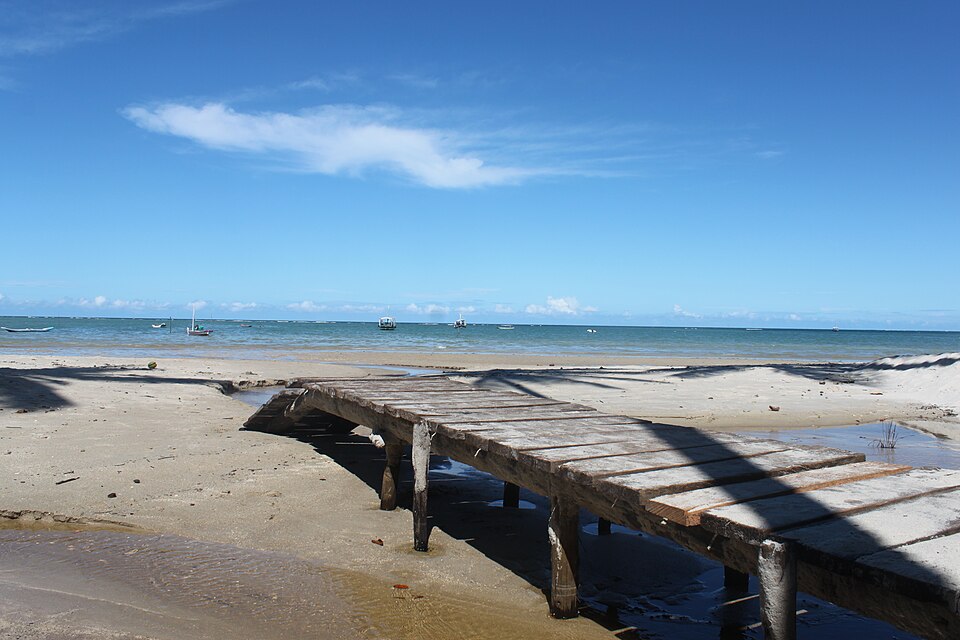
Eleven in the morning where the stone street ends and the sand begins: walk south and see how far you get, or go back two streets and pay for a ride. Here is what each option costs, how long it takes, and which one the tide cancels.
September 11, 2026 · 11 min read
Planning
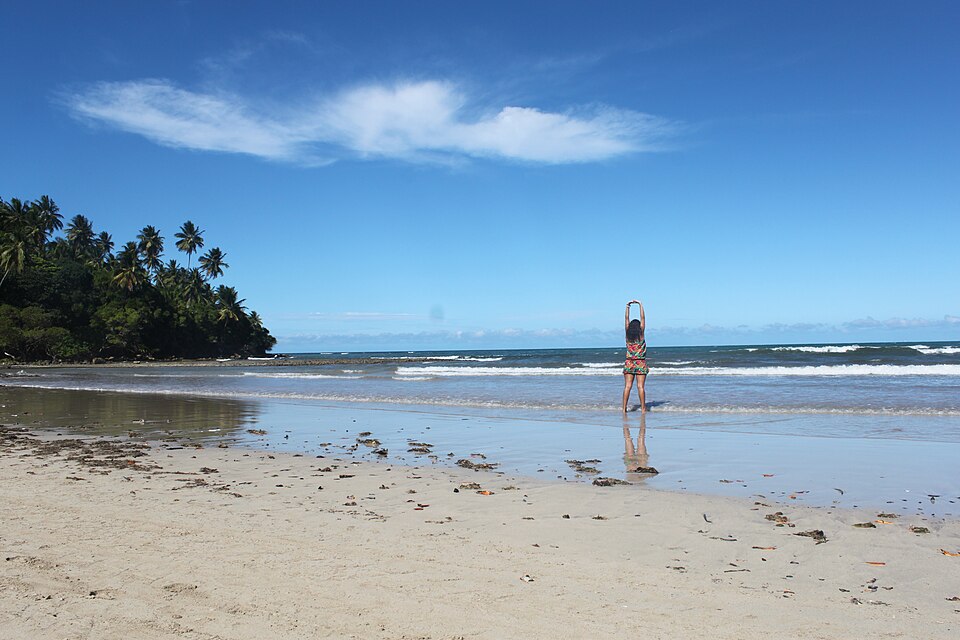
Last Thursday of March, a white curtain of rain crossing the channel, and nobody in the village running. April 2028 is not one month: it is two empty weeks with two holidays wedged between them.
September 11, 2026 · 9 min read