Your kid falls asleep in the car fifteen minutes before you arrive. Every parent knows that silence: the head tipped sideways, the seatbelt mark on the cheek, and the calculation you start running about whether you can carry them in without waking them up. On the way to Boipeba that nap almost always lands on a boat, somewhere between the mangrove channels and the moment the engine drops to idle at Boca da Barra.
We run flats in Velha Boipeba and we meet families at the pier most weeks of the year. This is the honest version of what an island with no cars, no pharmacy chain and no resident paediatrician does to a holiday with children: what works better here than anywhere else, what genuinely does not work, and the handful of decisions that separate a good week from a hard one.
The journey is the hard part, not the island
Say this out loud before you book: getting to Boipeba takes most of a day. From Salvador airport the cheapest route is ferry to Bom Despacho, bus to Valença, then the fast boat, and it runs seven to eight hours door to door. The route through Morro de Sao Paulo, catamaran plus 4x4 plus a ten-minute boat, is about five hours and costs around R$ 300 to R$ 400 per person, roughly US$ 60 to US$ 80 at the September 2026 rate of about R$ 5.50 to the dollar.
Neither of those is a bad day with a seven-year-old. Both are a long day with an eighteen-month-old. Three rules we give every family:
- Land in Salvador before 11:30 am or plan to sleep on the mainland. The last fast boat from Valença leaves at 4 pm. A missed boat with a toddler is the worst hour of the trip.
- Break the journey on purpose. A night in Salvador at the start turns a brutal transfer into two easy half days, and Salvador with kids is genuinely good.
- Book the semi-terrestrial transfer if you are travelling with a baby or with grandparents. It starts around R$ 250 per person and someone else owns your connections. Our full breakdown is in how to get to Boipeba from Salvador.
Seasickness tablets, if your child is old enough for them, go in the pocket you can reach without opening the bag. The catamaran crossing of the open bay is the part that gets people.
What works brilliantly: shallow water within walking distance
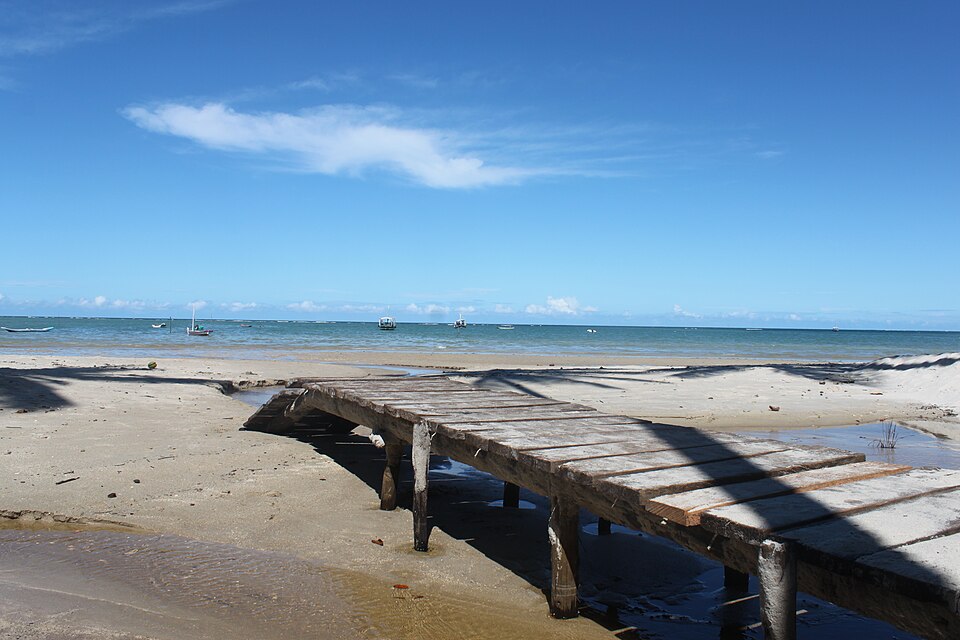
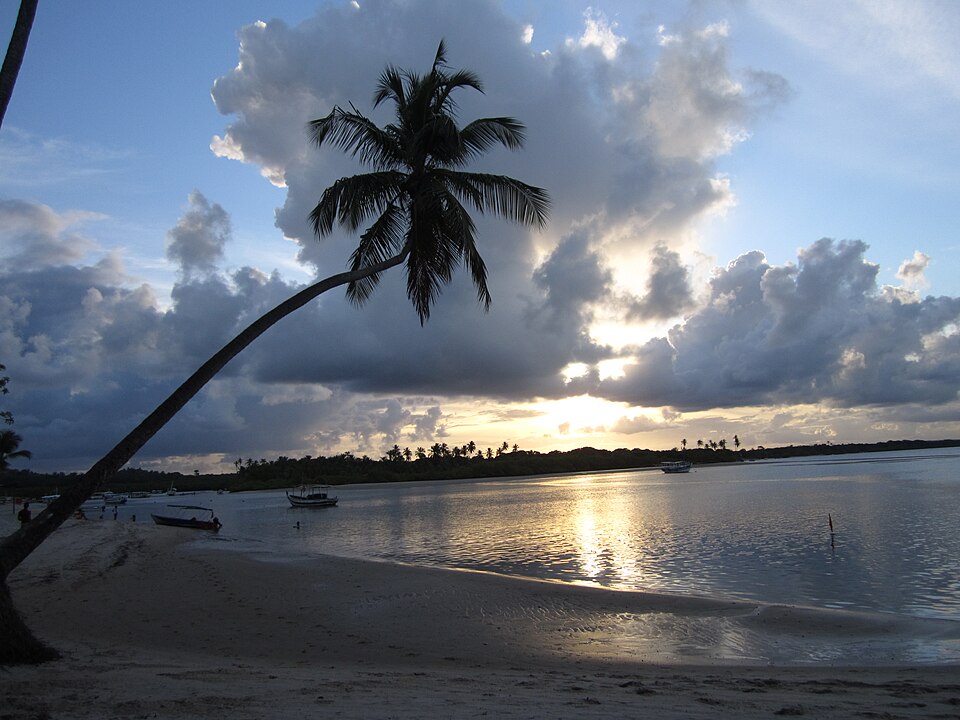
Boca da Barra is a two-minute walk from the village square and from our flats. A river meets the sea there, which means a wide, flat, warm shallow that stretches out further the lower the tide goes. Small children stand up in it. That single fact is the reason families come back.
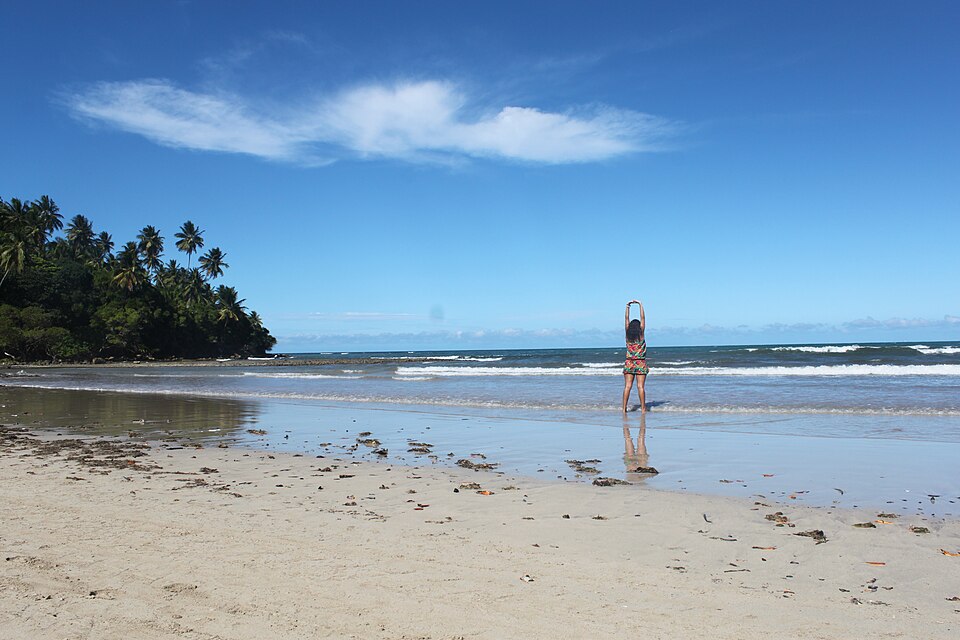
Tassimirim, the next beach south, is a flat walk of about thirty minutes along the sand and turns into a chain of warm tidal pools at low tide. Cueira is longer and emptier, with a barraca for lunch. And Moreré, the postcard, produces natural pools over the reef only around low tide, which is why the tide table decides your week rather than the calendar. We wrote the whole timing logic in the Morere natural pools tide guide.
Two safety notes we repeat every week. At the river mouth the outgoing tide pulls, so keep small children on the beach side of the channel. And on the reef at Moreré, a coral cut is the most common injury we see: water shoes, not flip-flops.
The tractor is the ride they will talk about
There are no cars on Boipeba. Getting to Moreré means walking, a boat, a quadricycle or the tractor, which tows an open trailer with bench seats across sand tracks and through puddles. It costs about R$ 15 per person and usually leaves once it has around six passengers. Children treat it as a fairground ride. Adults hold onto the rail and discover their spine.
Quadricycles run the same routes faster, roughly R$ 35 to R$ 40 per person to Moreré and R$ 15 to R$ 25 to Cueira. With a small child on board we prefer the tractor: slower, lower, no helmet argument.
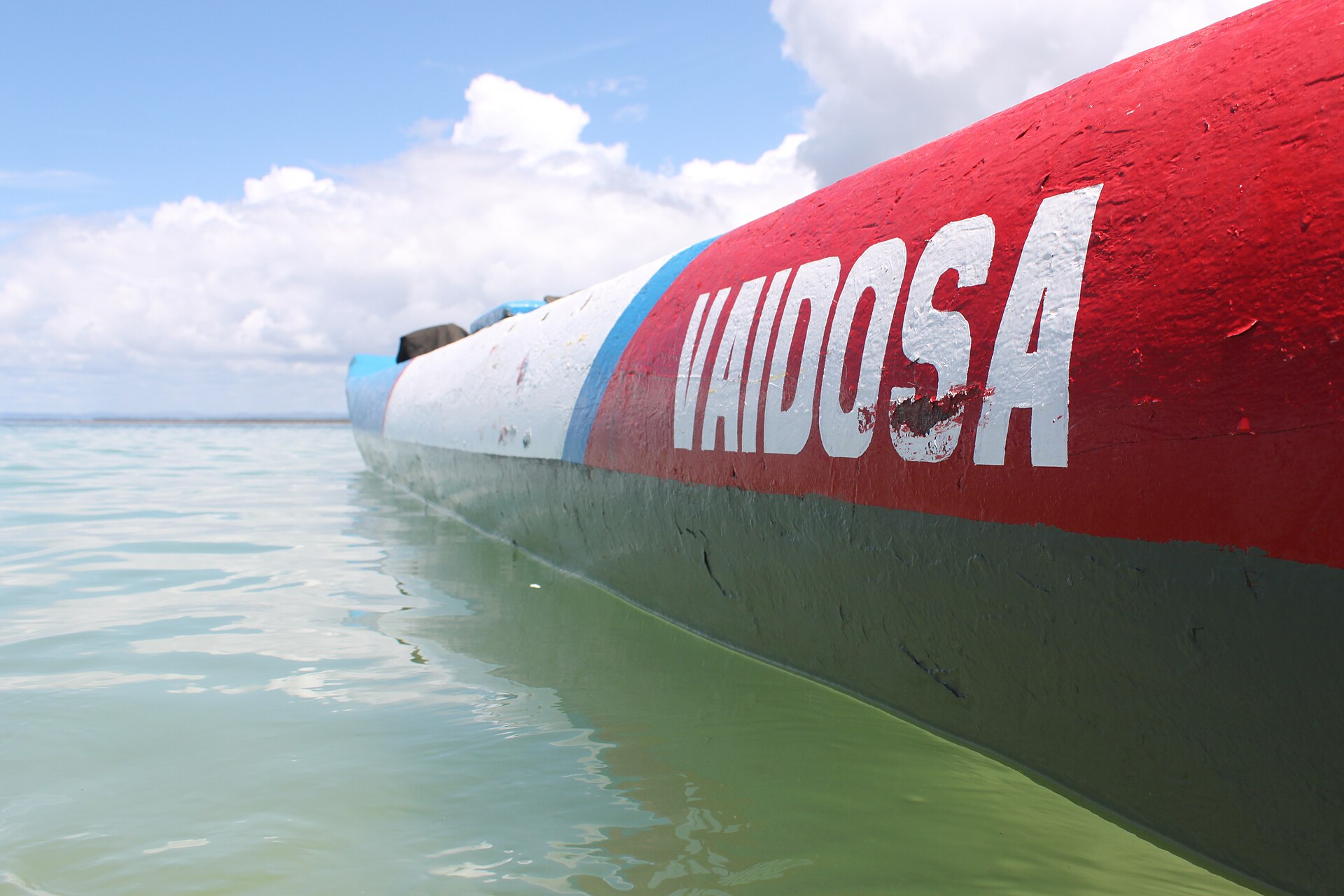
Boats are the other way to move, and here is the thing nobody tells you: the boats do not reliably carry child-size life jackets. Adult jackets do not work on a fifteen-kilo body. If your child cannot swim confidently, bring a jacket from home. It weighs almost nothing and it is the single most useful thing in a family suitcase here.
What does not work, said plainly
- There is no resident paediatrician. The village health post on Praça de Santo Antônio operates around the clock with on-call cover at weekends, and the island has an ambulance and an ambulancha, the boat that carries emergencies to the mainland. For anything beyond first aid, the hospital is in Valença, a boat ride away. That is fine for a fever and stressful for anything worse.
- Mosquitoes at dusk. From late afternoon, near gardens and the mangrove side, they arrive. Repellent with icaridin, long sleeves at sunset, and a plug-in or a mosquito net for the cot.
- The sun. Thirteen degrees south of the equator burns children in under half an hour at midday. We plan our own family days around a 10 am to 3 pm indoor block.
- Nothing is delivered. No supermarket, no ATM, and specific brands of formula, nappies or allergy medicine may simply not exist here. Buy them in Salvador.
- Distances are walked. If your child still needs carrying at the end of the day, you will be the one carrying them home over sand.
Stroller or carrier
Carrier, almost always. The village has stretches of paving where a stroller rolls fine, and plenty of sand, gravel and steps where it does not. A soft structured carrier gets you onto boats, up the pier steps and along the beach path to Tassimirim without a fight.
If your child is heavy and you want somewhere to park them for naps, bring a compact stroller with fat wheels and accept it lives in the village. Do not bring a large travel system. It will be carried more than it carries.
Food, water and the routine
Restaurants in the village are family-normal: sand floors, plastic chairs, and nobody who minds a toddler walking laps around the table. A prato feito, the plate of the day, runs from R$ 35 and feeds a small child alongside an adult. Fried fish, rice, beans, farofa and plantain is a menu most children accept. Portions of moqueca for two run R$ 90 to R$ 150 and are easy to share three ways.
Kitchens run at island speed. Order the child's food first, or ten minutes ahead by WhatsApp if you are heading somewhere specific. Water: our flats keep filtered water, and bottled water is in every shop. Ask for the juice without ice if you are cautious in the first days.
The sleep routine survives here better than in a hotel, for one boring reason. Village nights are quiet by ten, and a flat with a door between you and the sleeping child gives you an evening. Bring a white-noise app, earplugs for yourself, and accept the roosters at five. Blackout is worth solving: a spare sarong and two clothes pegs over the window is the trick every travelling parent works out eventually.
How many days, and what to pack
Four to five nights is the number that works. One arrival day that is mostly travel, one slow day at Boca da Barra, one tide-timed day at Moreré, one boat or Castelhanos day, one departure. Fewer than four and the journey eats the holiday.
The kid-specific packing list, on top of our general packing guide: child life jacket, water shoes, rash vest with sleeves, sun hat with a neck flap, repellent suitable for their age, a thermometer, oral rehydration salts, paracetamol or ibuprofen in your usual dosage, plasters, any prescription for the whole trip plus three days, nappies for the whole trip, and one small torch for walking home on unlit lanes.
And cash. There is no ATM on the island, card machines depend on a signal that drops, and the tractor driver does not take cards. Details in money in Boipeba.
Perguntas frequentes
Is Boipeba safe for young children?
Yes, with the normal cautions. The village is calm and walkable, there is a police post on Rua Nova, and traffic is not a risk because there are no cars. The real risks are sun, the current at the river mouth on an outgoing tide, coral cuts on the reef and mosquitoes at dusk.
Is there a doctor or a pharmacy on the island?
There is a health post on Praça de Santo Antônio in Velha Boipeba with round-the-clock cover and two pharmacies in the village stocking Brazilian brands. There is no resident paediatrician and no hospital; serious cases go by ambulancha to Valença. Bring your own medicines and message us on WhatsApp if you want us to check what is open on your dates.
Which beach is best with a toddler?
Boca da Barra, two minutes from the village, where the river meets the sea and the shallows are wide and warm. Tassimirim at low tide is the second choice and an easy walk.
Can we bring a stroller?
You can use one on the paved parts of the village, but sand, steps and boats defeat it. A carrier is the tool that actually works, with a compact stroller as an optional extra for naps.
How many days do we need with children?
Four to five nights. The journey from Salvador takes most of a day in each direction, so a three-night trip spends half of itself in transit.
If you want a ground-floor flat close to the calm water, look at our flats in Velha Boipeba or tell us your children's ages on the stay page and we will tell you honestly which one suits your family.