Eleven in the morning at the end of the village street, where the stone gives up and the sand begins. Backpack on, water bottle already warm, and the decision sitting there in front of you: walk south along the beach and see how far you get, or go back two streets and pay someone to drive you.
We run ten flats in Velha Boipeba, and that exact pause happens on our doorstep several times a day. Guests stand in it for five minutes because nobody told them what the options actually cost, how long each one takes, and which of them stops working when the tide comes in. This is that missing page.
No cars is a law here, not a marketing line
Boipeba sits inside the Tinharé and Boipeba Islands Environmental Protection Area, created by the state of Bahia in 1992, 43,300 hectares of it, in the municipality of Cairu. Motor vehicle traffic is banned across the island. Not limited. Banned.
So the whole transport question comes down to five things: your feet, a tractor pulling a wooden-bench trailer, a licensed quad bike that works as a taxi, a boat, and a man with a wheelbarrow at the pier.
One consequence matters more than all the prices below. Distance here is measured in minutes and in tide, never in kilometres. A beach that is forty minutes away on a falling tide can be unreachable on foot two hours later, and no amount of money fixes that in the moment.
Walking is the default, and for most days it is enough
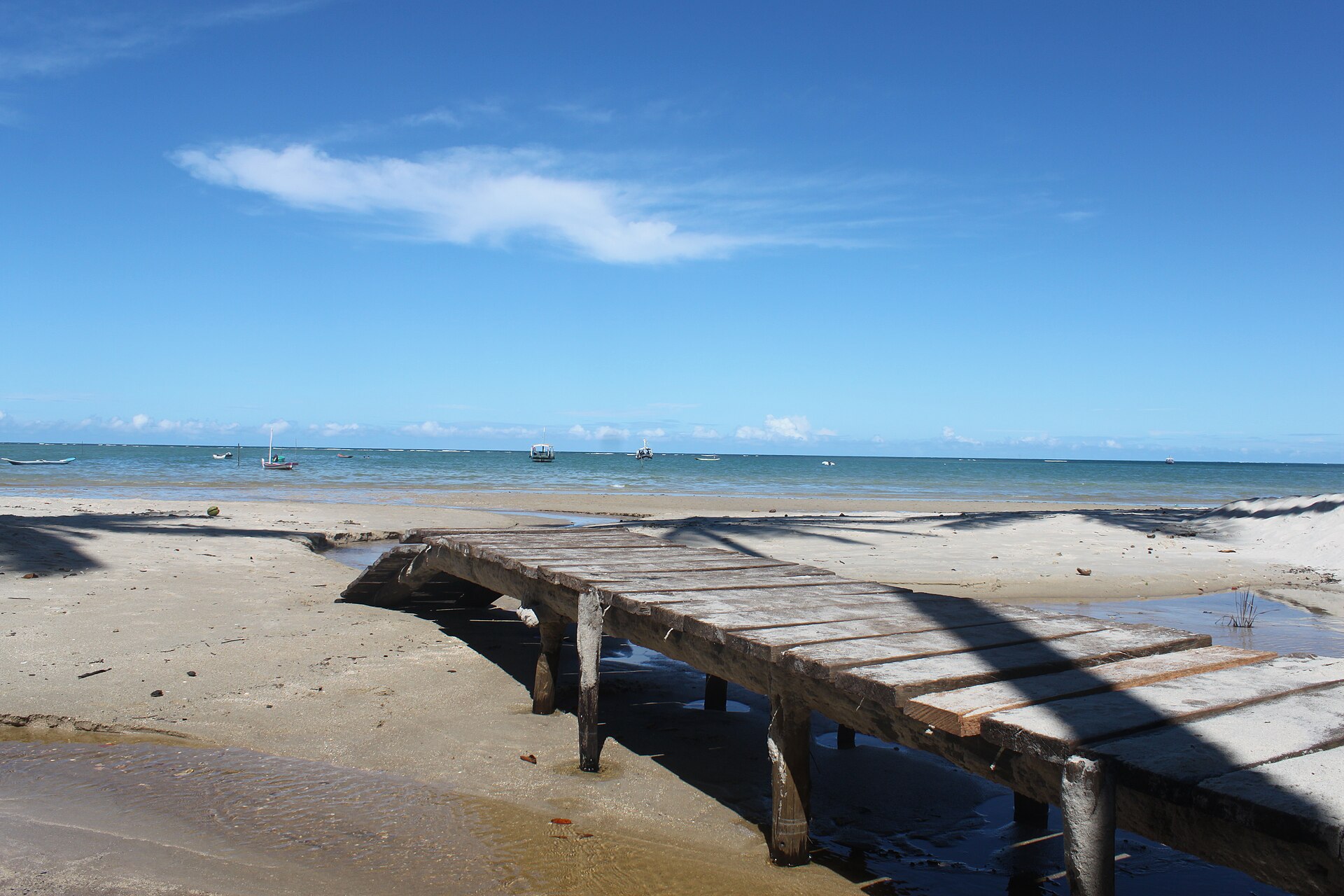
From the pier to the middle of the village is three to five minutes on stone. From the village to Boca da Barra, the beach the village faces, is two or three minutes and you do not need shoes. Our flats sit inside that triangle, which is the entire reason they are where they are.
Heading south, the beaches link up over firm sand at low tide:
- Village to Tassimirim: 20 to 30 minutes.
- Village to Cueira: 40 to 45 minutes, continuing past Tassimirim.
- Village to Moreré, the island's second village: about two hours on the sand, if the tide is falling and you left early.
- Moreré to Bainema: another 20 minutes.
- Bainema to Ponta dos Castelhanos: about an hour and a half at low tide, with almost no shade the whole way.
There is an inland track for when high tide eats the beach. It works, but it is harder going: soft sand, more sun, no sea breeze. Islanders use it and do not complain. Visitors who pick it at one in the afternoon carrying a beach bag usually regret it.
Practical notes, learned the boring way: flip-flops for sand, something with a sole for the stone street, two litres of water per person for anything past Cueira, and a hat. The beach-by-beach breakdown is in our beaches guide.
The men with wheelbarrows at the pier
When the boat from Valença ties up, there are men waiting with wheelbarrows. That is a job, not a hustle. It starts at around R$ 20 a bag (roughly US$ 4), and the honest advice is to agree the price before the bag goes into the barrow rather than after it arrives at your door.
If you tell us which boat you are on, we meet you at the pier and sort it out with you, which removes the entire negotiation from your first ten minutes on the island. Our how to get here page lists which crossing puts you here at which hour.
The quad taxi, the closest thing to a car
The quad taxi is the island's cab. Drivers work from two points in Velha Boipeba: Ponto da Tiririca, behind the village, and Ponto do Ribeirinho. The association publishes a fixed table, and these were the fares in force the last time we checked it:
| Route |
1 passenger |
2 passengers |
| Tiririca to Moreré |
R$ 25 (about US$ 4.5) |
R$ 40 (about US$ 7.5) |
| Moreré to Ribeirinho |
R$ 35 (about US$ 6.5) |
R$ 50 (about US$ 9) |
| Moreré via Monte Alegre to Tiririca |
R$ 30 (about US$ 5.5) |
R$ 50 (about US$ 9) |
| Moreré via Monte Alegre to Ribeirinho |
R$ 40 (about US$ 7.5) |
R$ 60 (about US$ 11) |
On top of that table: an urgent delivery run adds about R$ 5 (roughly US$ 0.9) per leg, a ride between 10pm and 5am adds about R$ 5 per person, and a medium or large dog adds around R$ 15 (about US$ 2.75). The limit is two passengers per machine plus one modest bag.
The run to Moreré takes about twenty minutes on an interior track. It is fast, it is dusty, and in the dry months you arrive the colour of the road. Wear sunglasses even if it is cloudy.
The tractor
The tractor is the oldest, slowest and most sociable option: a farm tractor pulling a trailer with wooden benches, leaving from Rua Tiririca. It takes twenty to forty minutes to Moreré depending on what the last rain did to the track.
Two prices circulate and both are real. Chartered for your own group, the trailer runs around R$ 150 (roughly US$ 27) for one to six people and R$ 250 (roughly US$ 46) for seven to fifteen. Running as a shared service, the figure quoted is somewhere around R$ 13 to 15 per person per leg (about US$ 2.50). Which one applies depends on the day, the season and how many people are going. Ask at the stop, or ask us.
Worth doing once for the experience. Worth skipping if you are in a hurry or your back does not enjoy surprises.
Boats between the villages
From Boca da Barra you can charter a boat to Moreré, about twenty-five minutes. The figures quoted recently were around R$ 250 (roughly US$ 46) in the small boat for one to four people and R$ 400 (roughly US$ 73) in the bigger one for five to ten. That is per boat, not per person, which makes it reasonable for a group of four and expensive for a couple.
Two honest caveats. The boat depends on the tide, so the departure time is not yours to choose. And from April to September the sea is livelier; some days it simply does not run. Arrange it the evening before, either with us or at the pier, and keep the quad as plan B.
The full day trips, with what each one includes, are in our boat tours guide. The island circuit starts at R$ 250 per person (roughly US$ 45), the Moreré natural pools run R$ 120 to 125 (about US$ 22), and Ponta dos Castelhanos is R$ 165 to 200 (roughly US$ 30 to 36).
Times and prices, side by side
| From, to |
On foot |
Tractor |
Quad |
Boat |
| Pier, village |
3 to 5 min |
no |
no |
no |
| Village, Boca da Barra |
2 to 3 min |
no |
no |
no |
| Village, Tassimirim |
20 to 30 min |
no |
no |
no |
| Village, Cueira |
40 to 45 min |
no |
no |
no |
| Village, Moreré |
about 2 h at low tide |
20 to 40 min, R$ 150 (US$ 27) for 1 to 6 |
20 min, R$ 25 (US$ 4.5) one, R$ 40 (US$ 7.5) two |
25 min, R$ 250 (US$ 46) for 1 to 4 |
| Moreré, Bainema |
20 min |
no |
no |
no |
| Bainema, Castelhanos |
about 1 h 30 at low tide |
no |
no |
usually on a tour |
| Boipeba, Valença |
no |
no |
no |
about 1 h 30, R$ 63 (US$ 11.5) |
Everything above is an order of magnitude, not a quote. Fuel, season and demand move these numbers. If a price or a departure time is load-bearing for your plan, message us on WhatsApp before you travel instead of budgeting off a web page.
What the tide actually decides
Three things, and only three, but they are the three that ruin afternoons.
First, the beach route south. On a rising tide the sand narrows until the sea meets the rock and vegetation, and then you are on the inland track whether you planned to be or not.
Second, the natural pools at Moreré. They exist as pools only around low tide. Arriving at high tide means arriving at a bay, which is lovely and is not what you came for.
Third, small boats. Departure windows follow the water, not the clock.
The tide table is free and public, and looking at it the night before is the single highest-return five minutes of the whole trip. We keep a printed one at reception and we will send you the week's times if you ask.
After dark
The main streets of the village are lit. The beaches and the tracks between villages are not lit at all, and there is no regular night transport.
Bring a torch, and remember your phone battery is also your only light. Restaurants close early here, so walking home at nine at night is normal and calm inside the village. A quad can be arranged at night if you fix it in advance, with that R$ 5 surcharge (about US$ 1) after 10pm. Walking the beach between Velha Boipeba and Moreré after dark is not something we recommend at any tide.
Where you sleep decides how much of this you need
If you stay in the village, most days involve no transport at all: pier, restaurants, church square and beach are all inside a five-minute walk. If you stay out at a beach, the quad and the tractor become part of your daily budget. How to reach each beach from the village, and how long the walk takes, is in the beaches of Boipeba, one by one.
One last practical thing: there is no ATM on the island. That sentence is final. Tractor drivers, quad drivers, porters and boatmen deal in cash and Pix, so arrive with reais in hand.
Frequently asked questions
Are there cars or taxis in Boipeba? No cars. The island is inside a state environmental protection area created in 1992 and motor vehicle traffic is banned. The equivalent of a taxi is the quad taxi, a licensed quad bike working to a fixed price table, plus the tractor and trailer for groups and cargo.
How do I get from Velha Boipeba to Moreré? Four ways. Quad, about twenty minutes, R$ 25 for one passenger and R$ 40 for two (roughly US$ 5 to 7) from Ponto da Tiririca. Tractor, twenty to forty minutes, around R$ 150 chartered for up to six. Boat from Boca da Barra, about twenty-five minutes, around R$ 250 for up to four. Or on foot along the sand at low tide, about two hours.
Do I need to book transport in advance? Not for the quad in the village, where you turn up at the stop. Yes for boats, which depend on tide and weather, and yes for anything at night. Message us the evening before.
Can I bring a large suitcase? You can, but it will not roll. Sand and stone destroy wheeled cases. Porters with wheelbarrows work the pier from around R$ 20 a bag (about US$ 4); agree the price first. A soft bag or a backpack is far easier.
Is Boipeba accessible for a wheelchair or a pushchair? Partly. Pier to village to Boca da Barra is flat and short, and that is where most village life happens. Beyond that, soft sand stops ordinary wheels. Ask us before booking and we will tell you honestly what exists that week.
Want the pier, the village and the beach all within five minutes of your door? See the flats, then read how to get here before you buy the boat ticket.