It is a Thursday night, the dishes are done, and one of you has the laptop open on the shared calendar. There are four free days in the second half of February and neither of you wants to spend them the way you spent the last four. Somebody types "Bahia". Somebody else says the name of an island nobody at work has heard of. That conversation is where this article starts.
We run ten flats in Velha Boipeba and a good half of our guests are two people with a short window and a long flight behind them. A weekend for two works here. It works better if you get four or five decisions right, and they are not the decisions the booking sites ask you about.
Four days is the floor, and here is the arithmetic
Boipeba has no bridge, no road and no cars. Whichever route you take from Salvador, the last leg is a boat, and the scheduled fast boats from Valença leave at 10:00 (not on Sundays), 12:00, 14:00 and 16:00. Going home, the boats leave Boipeba roughly between 07:00 and 16:00.
Read that twice and the shape of the trip appears. A three-night weekend means: arrive Friday afternoon, two full days, leave on the first boat Monday. That is two beach days and a lot of travelling. Four nights turns it into three full days and one lazy morning, which is the difference between a trip you talk about and a trip you recover from.
If your flight lands in Salvador after 10:00 in the morning, you are not reaching the island that day. Sleep in Salvador and take the first ferry. We wrote the whole timing problem down in the last boat leaves at 4pm.
Friday: the pier, the tractor, and the light at five
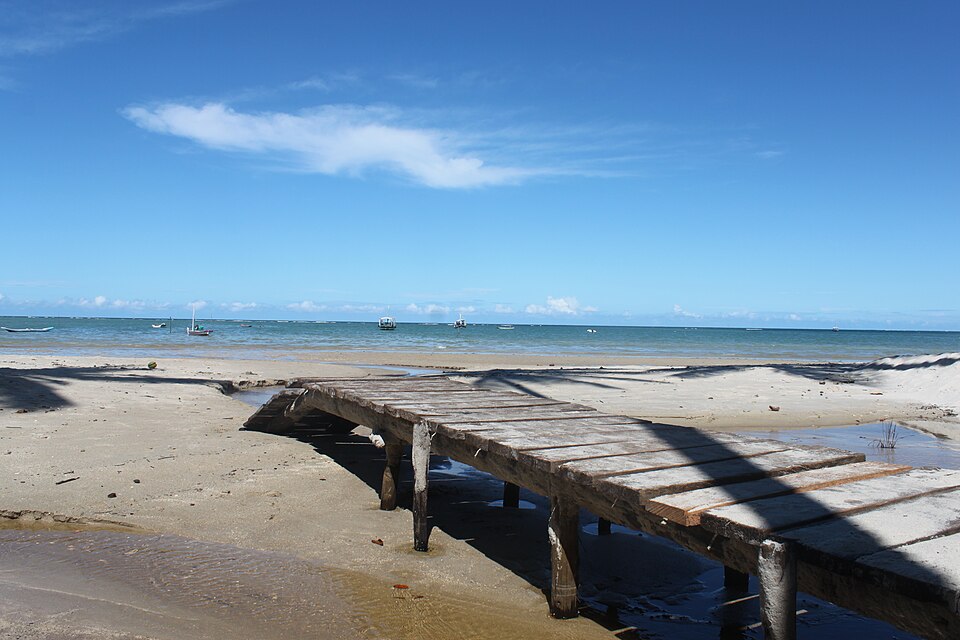
Your boat pulls into Boca da Barra, someone lifts the bags onto a tractor trailer or a wheelbarrow, and you walk. That is the whole arrival. From the pier to the flats is under three minutes on sand and packed earth, and you will do it in flip-flops with a bag of bread in your hand at some point over the weekend.
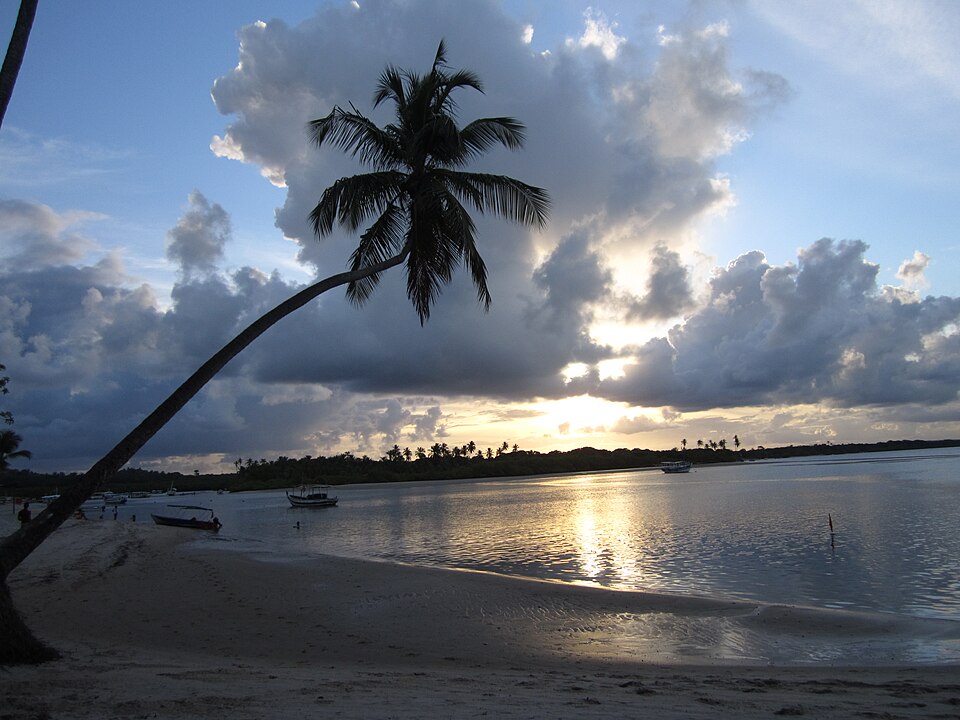
Drop everything and go to the beach before you unpack. Boca da Barra faces the mouth of the Rio do Inferno, which is the reason the sunset works: you are looking west, over the river, with the reef line and the boats in front of you. Brazil does not use daylight saving time, so the sun goes down early here all year, somewhere between about 5:20 p.m. in June and 6:20 p.m. in January. Be on the sand by five.
Two ways to watch it. The beach shacks at Boca da Barra put plastic tables straight on the sand and bring cold beer and coconut water; that costs the price of two drinks. Or you walk up to the terrace at O Céu de Boipeba, the sunset spot on the hill, which charges non-guests around R$50 per person and is open in the late afternoon. One is barefoot, one is a proper drink with a view. Do the first on Friday and the second on your last night.
Saturday: the boat day, and why to take the short one
Every couple who comes here asks about the boat trip, and almost every one of them books the wrong one. There are two.
Volta à Ilha goes right around the island in seven or eight hours: the Moreré natural pools, Ponta dos Castelhanos for lunch, then the mangrove side, Cova da Onça and Cairu. It costs about R$250 per person on a collective boat in 2026, roughly US$45. It is a great day. It is also seven hours of engine noise and sun, and on a four-day trip it eats the whole Saturday and most of your Sunday energy.
Castelhanos direct leaves Boca da Barra between 9 and 10, runs the length of the east coast in 40 to 60 minutes, drops you on a beach at the end of the island with a reef 100 to 200 metres offshore, and brings you back mid-afternoon. Five to six hours, about R$200 per person, and it needs eight passengers to run.
For two people on a short trip, take the direct one. Better still, ask about a private boat: from four passengers up, the per-head difference narrows, and you get to decide when you leave and how long you stay in the water. Prices for private boats move with fuel, so we ask the boatmen the night before rather than publishing a number we cannot stand behind. There is more detail in boat trips from Boipeba, including the Castelhanos route stop by stop.
One practical thing. The east coast of the island takes the trade wind, and the ride down can be bumpy for forty minutes. If either of you gets seasick, take the tablet an hour before boarding, not on the boat.
Sunday: the walk to Cueira, which is the actual romantic day
This is the day people remember, and it is free.
Leave the village mid-morning on a falling tide and walk south along the sand. The beach becomes Pedrinhas, a short rocky stretch, then opens into Tassimirim, then, after about forty to forty-five minutes total, into Cueira: a shallow cove backed by one of the biggest surviving coconut groves on the island, water clear enough to see your feet, and usually almost nobody.
There is a beach shack at Cueira run by Guido and Eliana that is an institution on this island, known for lobster cooked in butter with banana. It operates mostly in season and can be shut on a low-season weekday, so ask us on Saturday night whether it is open before you build the day around it. Carry R$150 per person in cash either way; card machines here depend on a phone signal that comes and goes.
Check the tide before you go. At high tide parts of the walk disappear under water and you end up on a path through the vegetation instead of on sand. The reasoning is the same one we use for the natural pools: leave on a falling tide, be back before it turns.
The hammock is not filler
Between two and four in the afternoon this island is genuinely hot and the light is bad for everything, including photographs. That is the hammock window. Every flat has a veranda and a hammock, and the correct use of it is a book, a fan, and the sound of somebody's tractor going past. We have watched a lot of couples arrive with a plan for every hour and then spend the third afternoon doing nothing at all, and that is usually the afternoon they mention in the review.
Dinner, and the honest version of "seafood by candlelight"
Velha Boipeba has more good kitchens than a village of roughly two thousand people should have, and they are all a few minutes' walk from each other around Praça Santo Antônio and the streets running down to the port.
- Varanda, on the square, is the one that fills first. The house gnocchi comes with several sauces, it is made in limited quantity each day, and it runs out early. Go at seven or accept the pasta and pizza.
- Flor de Lua, on the Rua do Porto, does careful plates like prawns with potatoes and mushrooms, and opens in the evening only.
- Casinha Latina, on the square, is the low-light, late, relaxed one, with boards, tacos and burgers rather than a full seafood dinner.
- The simpler kitchens in the village do moqueca, prawn stew and octopus for less money and, on a good night, better fish.
Expect roughly R$120 to R$220 for two with a drink in 2026, about US$22 to US$40. Opening days change with the season, and in April to July some places close on quiet weekdays. Ask us at check-in what is actually open that week rather than trusting a map pin. If a specific dinner matters to you, tell us before you arrive; outside New Year, restaurants here do not usually take reservations, but we can walk over and ask.
What four days for two actually costs
Rough 2026 numbers, per couple, not counting your flat. At roughly 5.5 reais to the dollar.
| Item |
R$ for two |
Notes |
| Salvador to Boipeba, classic route, each way |
about 200 |
Ferry, bus and fast boat, per person about R$100 |
| Castelhanos boat trip |
about 400 |
Collective boat, about R$200 per person |
| Lunch at a beach shack |
90 to 180 |
Fish, moqueca, prawn dishes |
| Dinner in the village |
120 to 220 |
Per evening |
| Tractor to Moreré, both ways |
52 to 60 |
About R$13 to R$15 per person each way |
| Quad-bike taxi instead |
100 to 120 |
R$25 to R$30 per person each way |
| Sunset terrace entry |
100 |
Around R$50 per person for non-guests |
Add it up and a four-day weekend for two, excluding accommodation, lands somewhere between R$1,400 and R$2,200, about US$255 to US$400. Accommodation on the island runs from around R$250 to R$400 a night for a simple pousada room for a couple, and R$500 to R$900 for something beachfront, according to prices published for 2025. Our own rates and season minimums are on the flats page.
When to book, and which week to pick
September to March gives you the calmest sea, the clearest water and the best odds of a dry evening. April to July is the rainy stretch on this coast; it is green, cheap and quiet, and it also rains on some of your afternoons.
Within any month, look at the moon. The lowest tides come around the new moon and the full moon, and a low tide falling between eight and noon is what makes the natural pools and the beach walks work. If your dates are movable by three days, move them for the tide.
Booking windows, from what we see: New Year needs to be booked by August, Carnival by November, and any other week is usually fine six to eight weeks out. Long weekends attached to Brazilian public holidays fill faster than the calendar suggests.
Five things not to do
- Do not plan a boat trip on your arrival day. You will get here at four in the afternoon with salt in your hair and no interest in another boat.
- Do not book the full round-island trip on a four-day weekend. Save it for a longer stay.
- Do not count on an ATM. There is no reliable cash machine on the island. Bring reais from the mainland, or arrive with Pix working on a Brazilian account.
- Do not schedule the day trip to Morro de São Paulo. On four days it is a whole day spent moving. If you are still choosing between the two islands, choose one and give it your four days.
- Do not arrive without telling us your boat. We meet every guest at the pier, and on a busy afternoon that is the difference between a three-minute walk and forty minutes of asking strangers.
The unromantic small print
At dusk the small biting midges come out on the beach and at the edge of the mangrove. Repellent at five in the afternoon solves it; discovering this at nine at night does not. There is no hospital on the island and anything serious means a boat to Valença, so bring the medication you take. The phone signal is real but moody, and it is worse in the rain.
None of that ruins anything. It is just the part nobody puts in the caption.
Frequently asked questions
How many days do we need in Boipeba for a couple's trip?
Four nights is the comfortable minimum: half a day to get here, three full days, and an early boat out. Three nights works if you land in Salvador in the morning.
Do we need to book restaurants in Boipeba?
Outside the New Year week, no. Turn up early instead, because the popular dishes run out rather than the tables.
Is there anything to do at night in Boipeba?
Dinner, a drink on the square, and the beach. There is live music some nights in high season and almost none in low season. If you want nightlife, that is Morro de São Paulo.
What is the best month for a romantic weekend in Boipeba?
September to March for sea and light. Within the month, pick the days around a new or full moon so the low tides fall in the morning.
Can we do Boipeba as a three-day weekend from São Paulo or Rio?
Only if your outbound flight lands in Salvador before 10:00. Otherwise the first day is spent on the mainland.
If this is the trip, look at the flats, read how to get here before you buy the flights, and message us with your dates. We will tell you what the tide is doing that week.