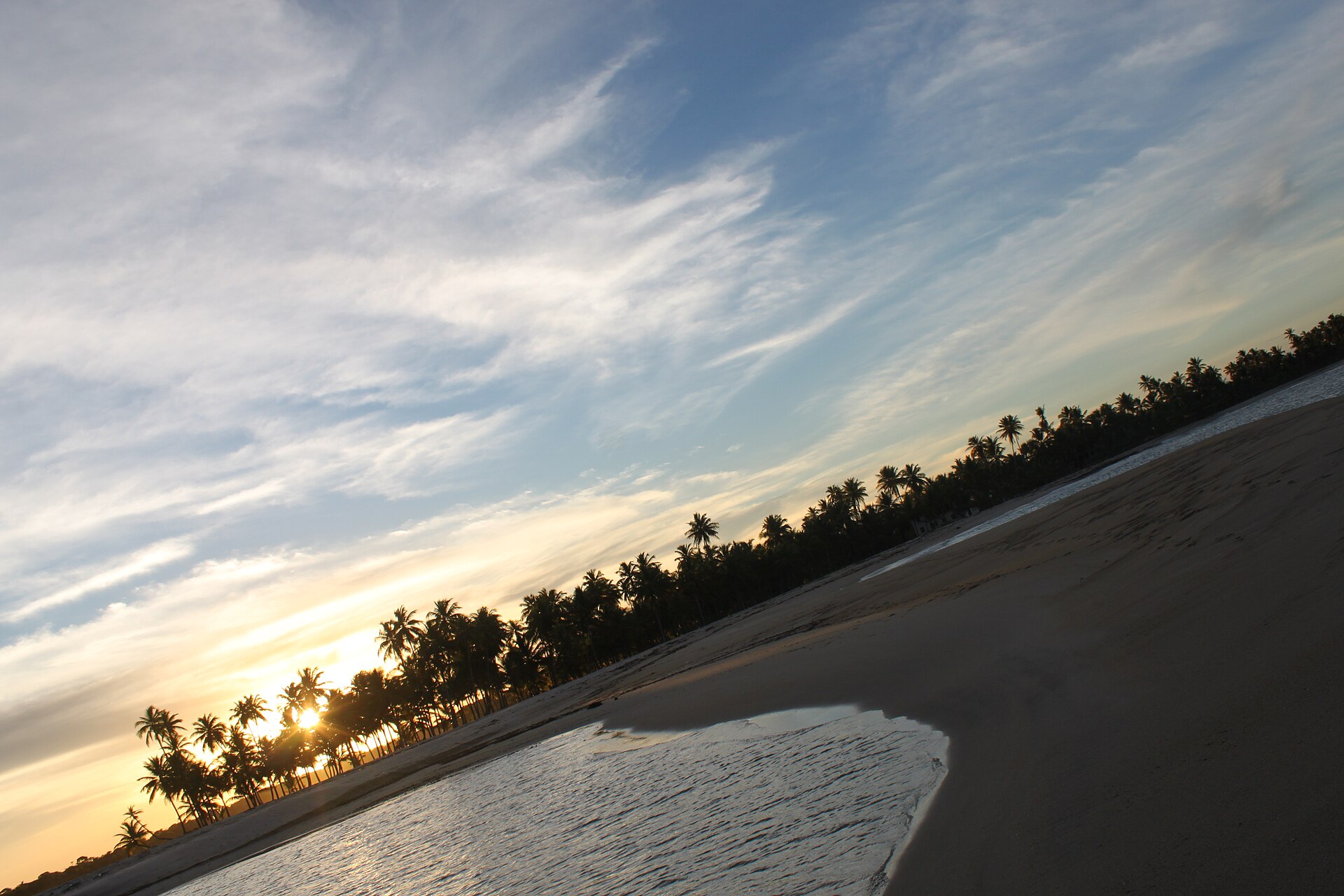
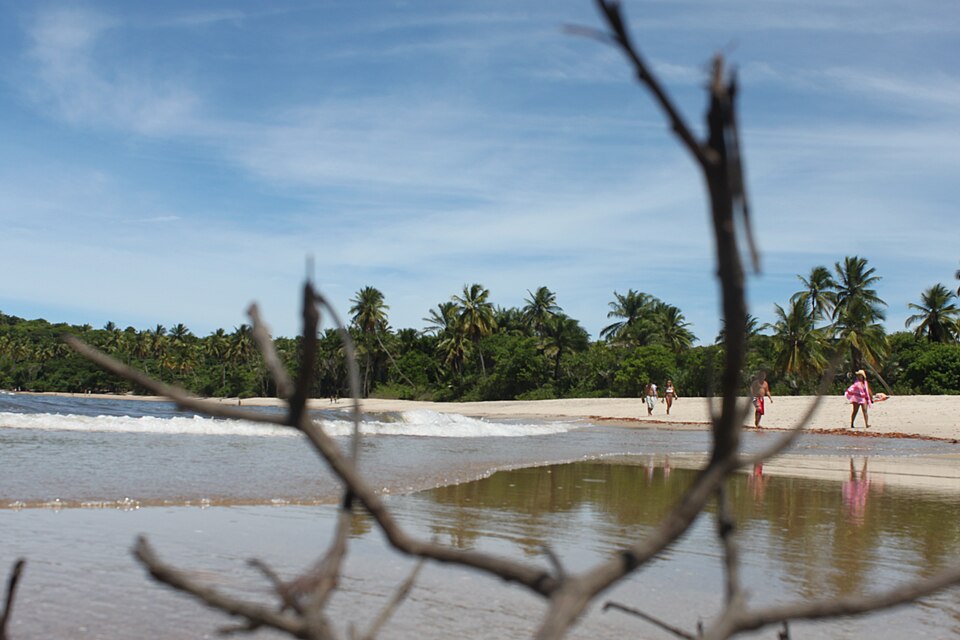
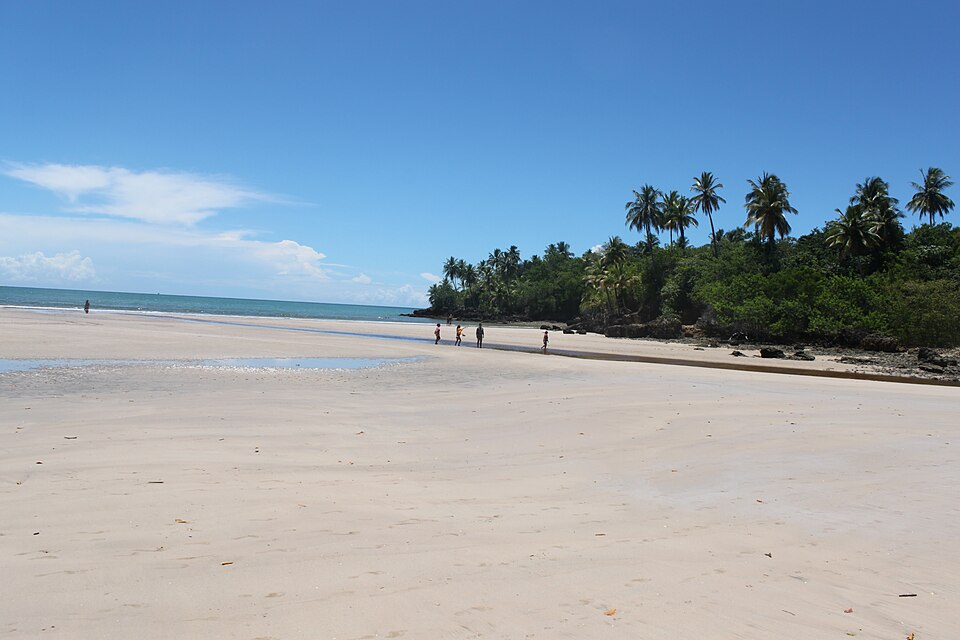
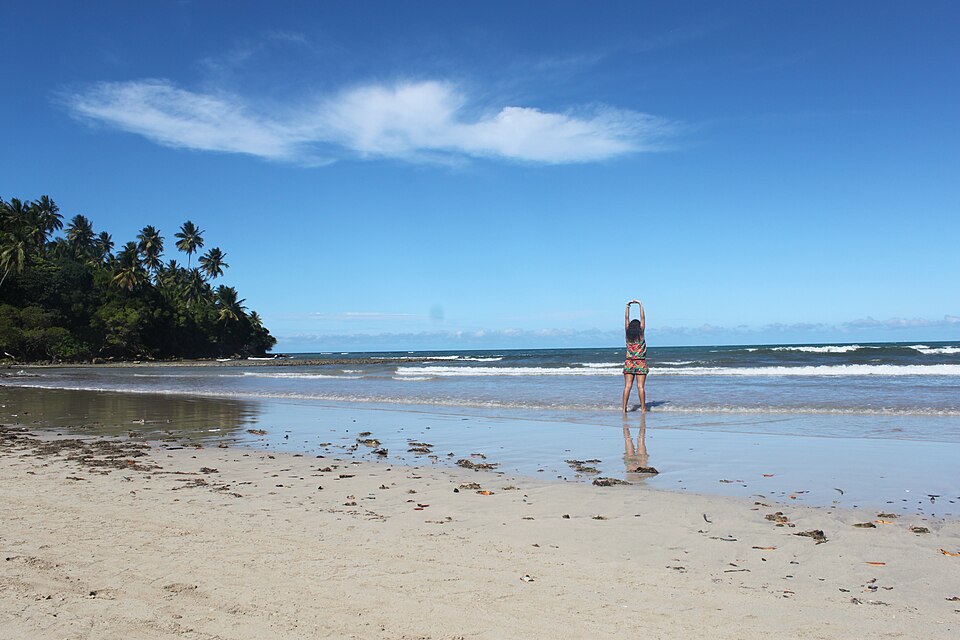
It is 6:40 in the morning in May and you are the only person on Boca da Barra beach. The tide is out, the sand is still cool, and the tractor that will carry today's luggage from the pier has not started yet. Somewhere behind the palm trees a rooster is making its case. You walk the whole beach to the river mouth and back, and in that hour you pass one fisherman fixing a net and nobody else.
That is low season in Boipeba. It is also the part of the year most travel guides tell you to avoid, usually in a single sentence about "the rainy months". We live here, and we think that sentence deserves a longer answer. This article is the honest version: what actually happens between April and July, what changes again from August to November, what closes, what gets cheaper, and who this quiet stretch of the year is for.
When is low season in Boipeba, exactly?
Boipeba runs on two calendars. The Brazilian school calendar sets the crowds: December to early March is high season, with a hard peak between Christmas and Carnival, and July brings a second smaller bump for the winter school break. The weather calendar sets the sky: on this stretch of the Bahia coast the wettest months are April, May, June and July, and the driest run from roughly September to February.
Put the two together and you get two different kinds of low season:
| Period |
Crowds |
Sky |
Sea |
| April to June |
Very quiet |
Rainiest stretch of the year, often in bursts |
Warm, some days choppy |
| July |
Busier (school break) |
Still wet, cooler air |
Warm |
| August to November |
Quiet, slowly filling from October |
Drying out, longer sunny runs |
Calm and clear from September on |
The stretch from mid-August to November is, in our opinion, the best-kept secret on the island: the rain is mostly gone, prices are still low, and the pools at Moreré are at their clearest before the summer plankton arrives. If you have flexible dates, aim there.
"Rainy season" does not mean rain all day
This is the part visitors get wrong most often, because it is genuinely hard to picture from a chart. Rain in Boipeba in May is not London drizzle from breakfast to dinner. It usually arrives as a burst: the sky goes dark over Tinharé, it pours for twenty or forty minutes, the gutters roar, and then it stops and the sand steams in the sun. Some days you get two of those. Some days you get none.
What you also get, and what nobody puts on a postcard, is the occasional three-day system that sits on the coast and rains on and off the whole time. In June 2025 we had one that lasted from a Tuesday to a Thursday. Guests who had planned a boat trip for the Wednesday moved it to Friday and went to the pools under a blue sky. Guests who had planned to leave on the Wednesday still left: the Valença boat runs in rain, and only cancels for real storms, which are rare.
Practical translation: in April to July, do not book a one-night stay around a single planned activity. Give yourself three or four nights so the sky has time to cooperate.
What is open and what is closed
Boipeba is small, and in the quiet months it gets smaller. Here is what changes on the ground:
- Restaurants. The main restaurants in Velha Boipeba stay open all year. A few beach barracas at Cueira and Moreré reduce their days or close midweek in May and June; the ones that stay open tend to be the family-run places that live here rather than seasonal operations. Ask us on the morning you want to go and we will tell you who lit the grill.
- Boat trips. The island-tour and Moreré boats run when there are enough people to fill them. In high season that is every day. In May it can mean waiting a day for a group to form, or paying for a private boat. The kayak and mangrove trips are less weather-dependent than the open-sea ones.
- Transport. The Valença fast boats keep their timetable all year. The Cidade Sol bus from Bom Despacho to Valença keeps running hourly. Nothing about getting here changes.
- Cash and pharmacy. The small pharmacy and the market keep normal hours. The ATM situation is the same fragile thing it is all year, which is a topic for another article.
What you will not find: queues for the boat, a wait for a table at 8pm, anyone on the Bainema trail, or a stranger's music on the beach.
What it costs
Prices on the island move with the calendar, and the gap is real. Roughly, for 2026:
- Accommodation on Boipeba drops by 30 to 50 percent from its Réveillon and Carnival peak. Weekly and monthly stays drop further, because owners would rather have a lit window than an empty one.
- Boat trips keep their per-person price (the island tour was around R$ 250, about US$ 45, in 2026) but private charters get negotiable when the boats are idle.
- Restaurant prices do not change. A moqueca for two still costs what it costs.
At San Diego Flats we publish a minimum number of nights and a "from" price per season on each flat page, and we keep the low-season number honest. Check the flats and you will see the difference without asking.
Who low season is for
We have watched enough guests arrive in May to know who leaves happy.
People who work remotely. A flat with a desk, a fast connection and a beach at the end of the street costs less in May than a studio in most cities. The rain burst at 3pm is a coffee break. See our notes on internet and remote work in Boipeba before you count on it.
Couples who want the island to themselves. Cueira with two people on it is a different beach from Cueira with two hundred. Sunset at the river with nobody else is the version people remember.
Anyone on a budget with flexible dates. The same trip in October costs a fraction of the same trip in January, and October's weather is better.
Readers. Rain on a tin roof and a hammock is a legitimate holiday.
Who it is not for: someone with three fixed days who has promised the children the natural pools. Book August to November instead, or come in summer and accept the crowds.
What we do differently in the quiet months
A pousada with ten flats and no restaurant has to be honest about what it can offer when the island is asleep. Here is what we do:
- We tell you, before you book, which weeks look thin on boat departures, so you can plan a private trip or come a day earlier.
- We keep a shelf of games, a rack of umbrellas, and a list of the three restaurants that never close.
- We offer weekly and monthly rates that make sense for people who want to stay and work.
- Our host is on the island all year. The WhatsApp number in your booking is a person, not a bot, and it works on a Wednesday in June.
Packing for the wet months
Two things beat everything else: a light rain jacket that packs small, and a second pair of sandals so one pair is always dry. Add a dry bag for the phone on boat days. Mosquitoes are more active after rain, so bring repellent you actually like. Leave the umbrella; the wind at the beach turns it inside out and the rain is warm anyway. Our full list is in what to pack for Boipeba.
The honest summary
If you want guaranteed blue sky and full boats, come between September and February and pay for it. If you want the island quiet, cheap and mostly sunny, come between mid-August and November. If you want it quiet and cheap and do not mind a daily downpour, April to June is yours, and you will have Boca da Barra at 6:40 in the morning all to yourself.
Frequently asked questions
Does it rain every day in Boipeba in May?
No. It rains most days for part of the day, usually in short heavy bursts, with dry sunny hours in between. Multi-day washouts happen a few times a season.
Are boat trips cancelled in low season?
Rarely for weather. More often they wait a day for enough passengers. Private boats run whenever the sea allows.
Is the sea warm in winter?
Yes. Water temperature on this coast stays in the mid-20s Celsius (high 70s Fahrenheit) all year.
When is the cheapest time to visit Boipeba?
April to June and again mid-August to November, outside Brazilian holidays. Weekly and monthly stays are cheapest of all.
Ready to see the quiet version of the island? Check the flats and ask us which weeks look best.