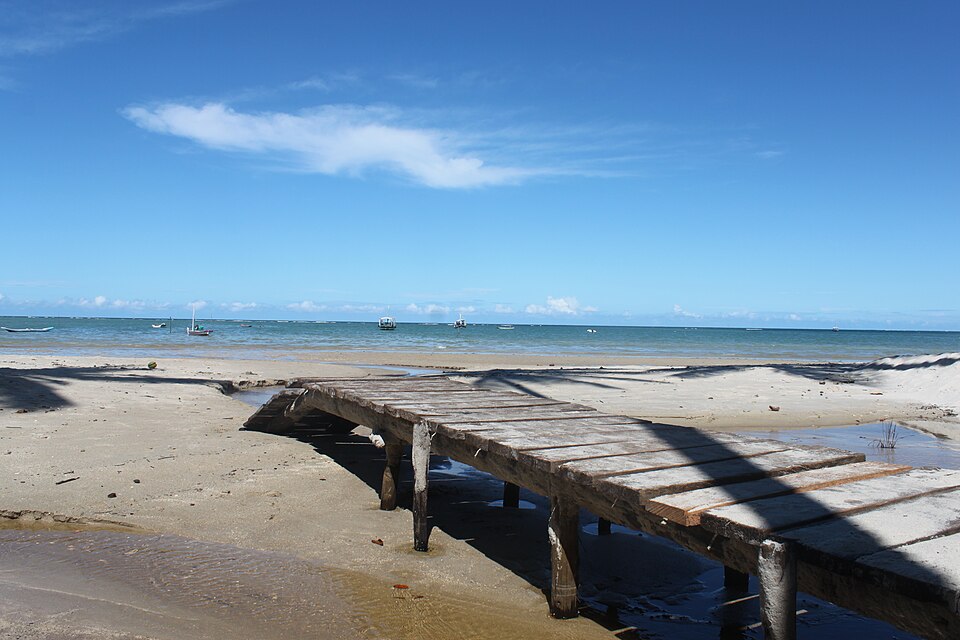
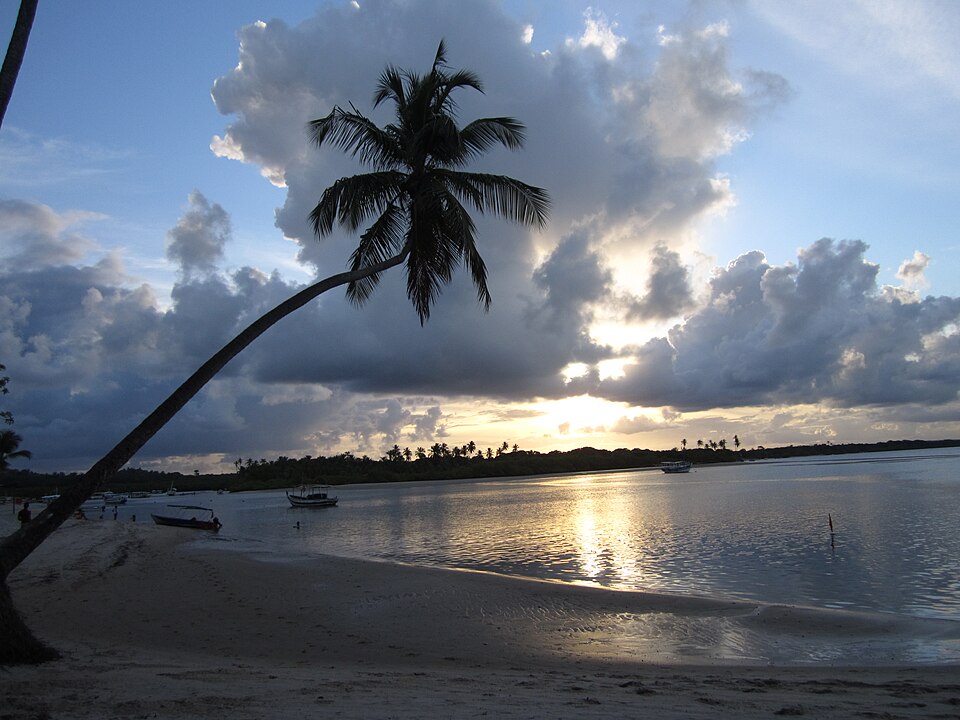
It is Tuesday night, your February flights are booked, and you have two browser tabs open. In one, a beach bar with speakers on the sand and two hundred people at sunset. In the other, an empty strip of sand with a tractor crossing it and nobody else in the frame. Same archipelago, ninety minutes apart, and you have to choose.
We run flats in Velha Boipeba, so you already know which way we lean. But we send guests to Morro de São Paulo most months, we go there ourselves for the pharmacy and the bank, and half our guests arrive through it. So here is the fair version: what each island is genuinely good at, what each one costs in 2026, and which kind of traveller ends up happier where.
Same archipelago, two different jobs
Morro de São Paulo is a village on the island of Tinharé, in the municipality of Cairu, on the southern coast of Bahia. Boipeba is the next island south, separated by a channel of river and mangrove. Getting from one to the other takes about an hour and a half by 4x4 across Tinharé plus a short boat crossing, or a full day if you do it as a boat tour.
Both islands are car-free. Both sit on the same reef, read the same tide table and eat the same fish. What differs is scale and what has been built on top of it.
Morro has roughly four thousand residents spread over several neighbourhoods, five numbered beaches, an airstrip with scheduled flights, banks, pharmacies, dive operators, a zip line that drops onto the First Beach, and a nightlife that runs until sunrise in high season. Velha Boipeba, our village, is a few hundred houses around a church square, one main street of restaurants, a pier, no ATM, no cars, and a beach at the end of the street.
Neither of those is better. They are answers to different questions.
Nightlife: this one is not close
If dancing on sand at 2am is part of the holiday you are picturing, go to Morro. The Second Beach is where the bars, the beach clubs and the luaus are, and in high season the parties are a scheduled part of the week rather than a happy accident. There is a large venue on the Fourth Beach for concerts and DJ nights. You will not run out of options in January.
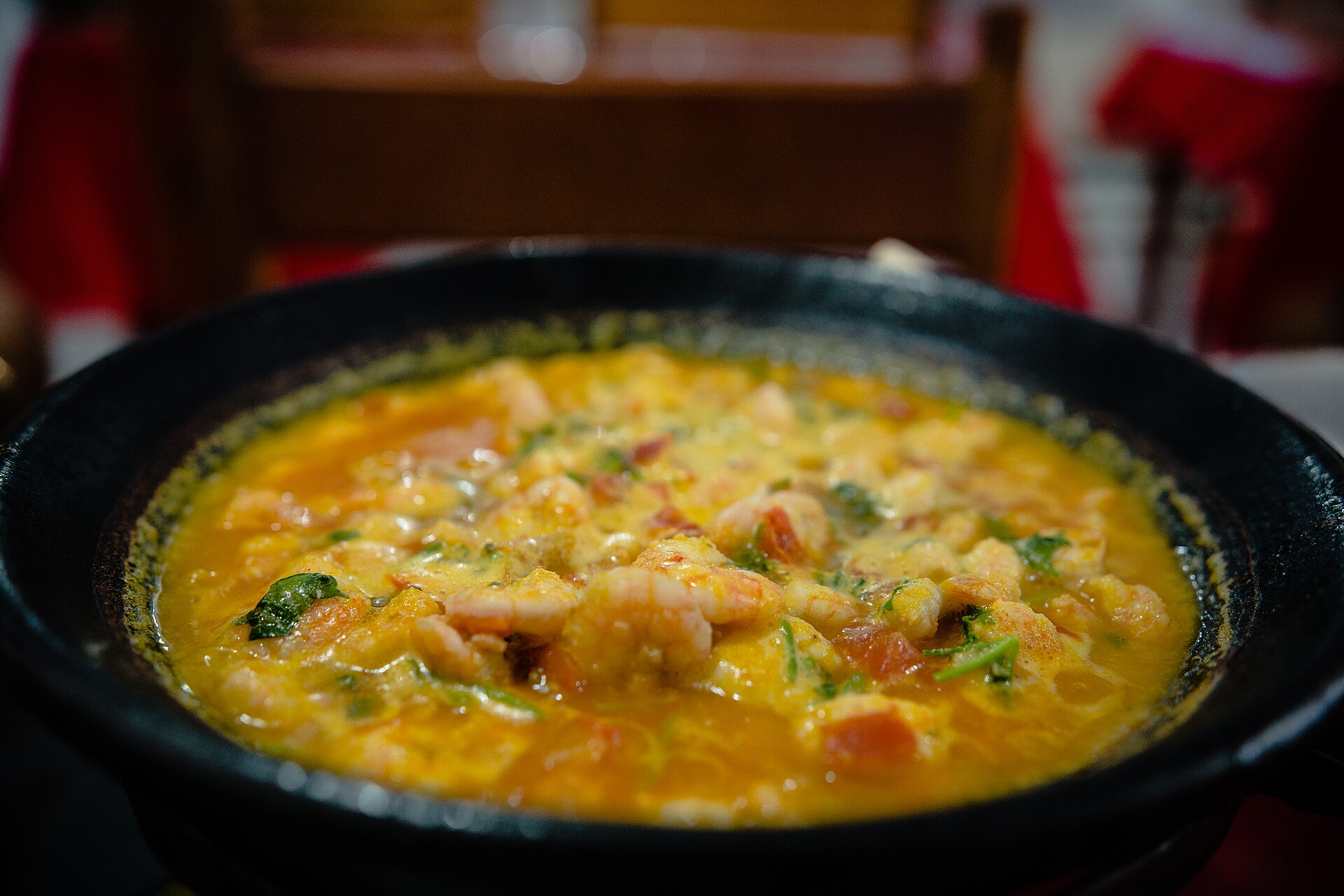
Boipeba's night is different in kind, not just in volume. On a normal Tuesday in Velha Boipeba, dinner starts at 19:00, the square fills with kids playing football, a bar with live music runs until around midnight and the street lights are off by the time you walk home. On weekends in season there is a party somewhere, usually a forró on the square or a sound system on the beach, and everybody knows about it by lunchtime. If your idea of a good night is a long dinner, a caipirinha on a plastic chair and a walk back along the water, that is exactly what you get here. If it is a beach club with a wristband, it is not.
Beaches: quantity versus emptiness
Morro's beaches are numbered from the village outward, First through Fifth, and that numbering tells you the whole story: the higher the number, the quieter and the further you walk. First and Second are urban beaches with structure at the waterline. Third and Fourth are wider and calmer, with beach clubs and natural pools at low tide. The Fifth, also called Praia do Encanto, is the long empty one.
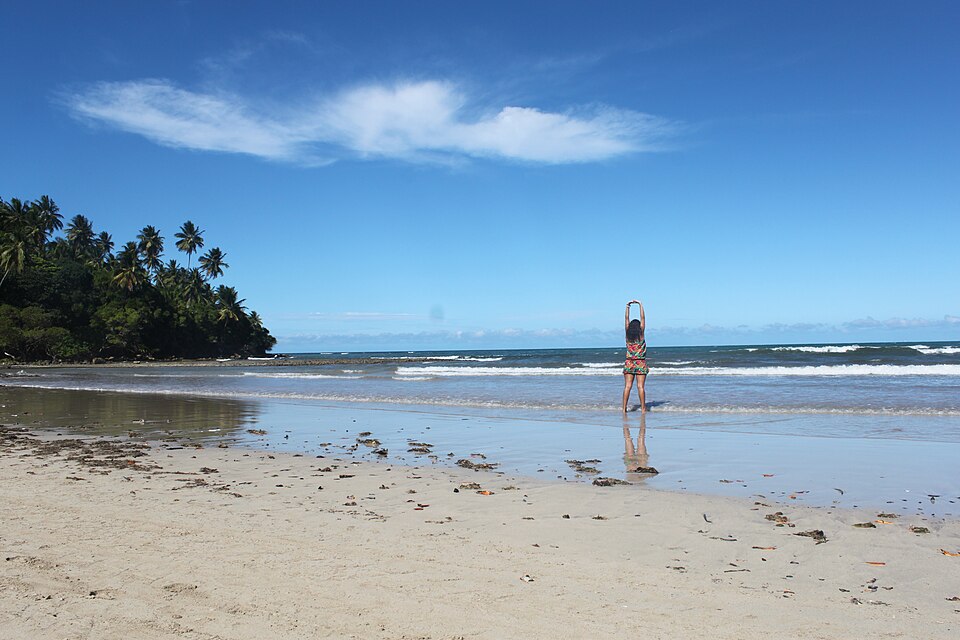
Boipeba's beaches run in a chain south from the village: Boca da Barra, Tassimirim, Cueira, Moreré, Bainema, Ponta dos Castelhanos, spread over more than twenty kilometres of coast. You reach the first three on foot, one after another, in twenty, forty and forty-five minutes of walking on sand. Moreré is six kilometres inland by tractor or a boat ride away. Castelhanos is a boat day.
The practical difference: in Morro, the beach is a place with services that you walk to in flip flops. In Boipeba, the beach is often a place with one shack, or none, and you carry your own water. On a Saturday in January, the Second Beach in Morro has thousands of people on it. On the same Saturday, Cueira has perhaps forty, and Bainema has you and a fisherman.
Getting there: Morro is simply easier
From Salvador airport, Morro is a taxi to the Nautical Terminal downtown and a catamaran across the bay, about two and a half hours on the water, with tickets between R$ 152 and R$ 172 per person in 2026. Or it is a twenty-minute flight to the airstrip. There is no leg where you have to change transport modes in a town you have never heard of.
Boipeba, on the classic route, is a ferry to Itaparica, a two-hour bus to Valença and a fast boat through the mangrove, seven to eight hours door to door for around R$ 100 per person. There are faster ways, which we lay out in how to get to Boipeba from Salvador, and by air there is only charter since scheduled flights stopped in June 2026. But the honest headline is that Boipeba costs you either half a day or extra money, and the last boat from Valença leaves at 16:00.
That difficulty is also the reason Boipeba is emptier. The filter is the journey.
What each island costs in 2026
Both islands now sit under the same tourist tariff, the TUPA, charged by the municipality of Cairu. For Morro de São Paulo it rose from R$ 50 to R$ 70 per visitor in December 2025 and a further increase to R$ 90 has been scheduled and postponed more than once during 2026, so check the current amount before you travel. For Boipeba a R$ 50 per visitor tariff was announced and then postponed, with no start date in force, so it is not being charged here today. Children under five and people over sixty are exempt, and students and low-income registered travellers pay half.
Beyond the tariff, day-to-day prices are similar for food and drink, because the fish comes from the same boats. Accommodation in Morro spans a much wider range, from hostel dorms to five-star hotels with pools on the Fourth Beach. Boipeba has small pousadas and flats, and almost nothing at either extreme.
Where Boipeba is more expensive is transport inside the island: a tractor to Moreré is around R$ 15 per person, a quad-bike taxi R$ 25 to R$ 30, and the full island boat tour about R$ 250 per person in 2026. Where it is cheaper is everything you do not do, because there is not much to buy.
One more practical difference: Morro has banks and card machines that work most of the time. Boipeba has no ATM at all, and card machines depend on the mobile signal that day. Bring cash in small notes.
With children
For families with small children, the answer is usually Boipeba, for one boring reason: distance from traffic and noise. The village is walkable, Boca da Barra is a river-mouth beach with calm shallow water two minutes from our door, and Cueira stays waist-deep a long way out. Children run around the square after dinner while parents finish their beer.
The counterargument is real, though. If your child needs a pharmacy at 22:00, Morro has one and we do not. If a teenager wants something to do that is not a beach, Morro has the zip line, the dive shop and the crowd. Families with teenagers often prefer Morro. Families with a four-year-old almost always prefer here.
As a couple
Both work, differently. Morro gives you a restaurant scene, sunset drinks with a view over the bay and the option of a night out. Boipeba gives you long empty beaches, a boat you can hire for the two of you, and dinners where nobody hurries you.
If it is a honeymoon and you want quiet, come here. If it is a first trip to Bahia with a group of friends who want variety, Morro will not disappoint you.
The comparison table
|
Morro de São Paulo |
Boipeba |
| Travel time from Salvador airport |
about 3 h by catamaran, 20 min by plane |
5 to 8 h by boat routes, 30 min by charter only |
| Cost of getting there per person |
R$ 152 to R$ 172 catamaran |
about R$ 100 classic route |
| Tourist tariff (TUPA) |
R$ 70 |
R$ 50 announced, postponed with no date in force |
| Nightlife |
Bars, beach clubs, luaus until sunrise |
Dinner, live music, quiet by midnight |
| Beaches |
Five, numbered, walkable from the village |
Six, spread over 20+ km, some by boat |
| Services |
Banks, pharmacies, dive shops, clinics |
Small shops, no ATM, patchy signal |
| Best for |
Groups, first-timers, nightlife, teenagers |
Couples, small children, walkers, long stays |
| Recommended stay |
3 to 4 nights |
4 to 7 nights |
Doing both in one trip
Plenty of people do, and the order matters. Morro first, Boipeba second, is the version that works: you arrive with energy for the noisy island, then come here to decompress before flying home. Doing it the other way round, most guests tell us Morro felt loud after a week of tractors.
Give Morro three nights and Boipeba four, and use the 4x4 and boat transfer between them, which takes about an hour and a half. Do not try to split a five-night holiday between the two; you will spend a day of it in transit.
How to choose in one line
Choose Morro de São Paulo if you want nightlife, structure, easy access, a wide range of hotels and plenty of organised things to do.
Choose Boipeba if the thing you want most is fewer people, and you are willing to pay for it with a longer journey, cash in your pocket and a village that goes to sleep early.
When you are ready, see the flats, read how to get here, and message us with your dates. If you are still deciding, how many days to spend in Boipeba will tell you what a week here actually looks like.
Frequently asked questions
Is Boipeba better than Morro de São Paulo?
Neither is better; they answer different questions. Morro has more infrastructure, more nightlife and easier access. Boipeba has emptier beaches, a quieter village and a longer journey to get there. Pick the one that matches the holiday you are picturing.
How do I get from Morro de São Paulo to Boipeba?
By 4x4 across Tinharé island to the crossing near Cairu and then a short boat ride, about an hour and a half in total, or as part of a full-day boat tour. Transfer companies sell the leg as a package; ask us and we will point you at one that runs on your date.
Which island is cheaper?
Getting to Boipeba is cheaper, at roughly R$ 100 per person by ferry, bus and boat, against R$ 152 to R$ 172 for the catamaran to Morro. Food is similar. Morro has a wider range of accommodation, from very cheap to very expensive, so your total depends more on where you sleep than on which island you choose.
Do I have to pay a tourist tax on either island?
Yes. Cairu charges the TUPA in Morro de São Paulo, where it has been R$ 70 per visitor since December 2025. For Boipeba a TUPA of R$ 50 per visitor was announced and then postponed, with no start date in force, so it is not being charged here today. Under-fives and over-sixties are exempt.
Can I visit Boipeba as a day trip from Morro de São Paulo?
You can, and many boat tours do exactly that, but you will see the natural pools at Moreré and little else, and you will be back on the boat by mid-afternoon. If Boipeba appeals to you at all, sleep here at least two nights.