Ten past eleven on a sandbank a kilometre off Moreré, water at your ankles, and you notice the boat is floating higher than it was ten minutes ago. The boatman noticed first. He does not say anything dramatic, he just picks up the cooler and starts walking back. That gesture is the entire tide lesson of Boipeba, and it is why this page exists.
The natural pools here are not a place you go to. They are an event with a start time and an end time, and the timetable is published for free by the Brazilian Navy. Read it and you get the island that shows up in other people's photographs. Skip it and you can spend R$250 per person on a boat day, roughly US$45 at the 2026 rate, swimming in the same blue you could have had from the beach for nothing.
Two highs, two lows, and a clock that slips
Boipeba sits on the southern coast of Bahia, in the Cairu archipelago, and the tide here is semidiurnal: two high waters and two low waters in a day. One complete cycle runs about 12 hours and 25 minutes, so the whole pattern slides forward by roughly 50 minutes every single day.
That slide is the most useful number on this page. If today's low water lands at noon, tomorrow's is near 12:50 and the day after near 13:40. A run of convenient midday low tides lasts a few days and then walks off into the late afternoon and out of your holiday. With three or four nights on the island you do not need luck, you need to pick the right day out of the ones you already have.
The size of the tide also breathes with the moon. Around new moon and full moon you get spring tides: the highs come in higher and, far more useful to you, the lows drop lower. Around the quarter moons you get neap tides that barely uncover anything. Same reef, same hour of the day, a completely different afternoon.
Where the numbers come from
In Brazil the official tide prediction belongs to the Navy. The Centro de Hidrografia da Marinha, known as the CHM, publishes the Tábuas de Maré at marinha.mil.br/chm, free, updated year by year. Every tide app and tide website you will find for this coast is repeating those harmonic predictions, sometimes with a global model filling the gaps between stations.
Use whichever interface you like on your phone. We keep the printed sheet on the wall at the flats and write the day's low water on the chalkboard by the door, because the mobile signal on this island has opinions of its own and they change hourly. One rule only: make sure whatever you are reading names its reference port. A tide table without a named port is a horoscope.
Which reference port to use for Boipeba
There is no tide station inside Boipeba itself. The standard rule when your town is not on the list is to use the nearest port station, and for us that station is Morro de São Paulo, about 26 km north on the neighbouring island of Tinharé. That is the port the boatmen here use, the one the local agencies quote, and the one we look at with guests at the kitchen table the night before a boat day.
It is close enough to plan a day around and not precise enough to plan a minute around. Treat the printed time as give or take fifteen minutes for Moreré, and treat the height as the real information.
What the height number actually means
If you are used to NOAA charts and feet, two things change here. Heights are in metres, and they are measured above chart datum, which in Brazil is called the nível de redução and sits close to mean lower low water. It is a floor, not sea level. That is why a table can print a negative number: the water has dropped below the chart's own zero, which is exactly when the reef tops come out to dry.
At Morro de São Paulo the recorded extremes run from about minus 0.3 m to about 2.9 m. An ordinary day is much tamer: high water around 2.3 to 2.4 m, low water around 0.2 m. So what you will actually live is a swing of roughly two metres, twice a day. And the difference between a 0.2 m low and a 0.8 m low is the difference between a pool you stand up in and a reef you swim over.
The height that opens the pools
The pools form where reef and sandbank sit just under the surface. When the water drops far enough, the tops drain and what is left is a chain of clear basins with fish shut inside them until the sea comes back. The practical threshold everyone works with on this island is a low water under 0.5 m. Below that you get the postcard. Above it you get a perfectly nice sea.
| Low water height |
What the reef gives you |
Our verdict |
| Below 0.3 m |
Banks fully exposed, pools waist deep or less, you can walk between them |
Best day of the trip, book the boat for it |
| 0.3 to 0.5 m |
Pools open and calm, chest deep in places, easy snorkelling |
Very good, the standard postcard day |
| 0.5 to 1.0 m |
Reef visible and worth a mask, but no walking between pools |
Worth going, manage expectations |
| 1.0 to 1.5 m |
Blue water over a reef you can sense more than see |
Go for the boat ride, not for the pools |
| Above 1.5 m |
Reef under two metres of moving water |
Pick a beach day instead |
The usable window is about two hours either side of the lowest point, so four hours at the very outside and comfortably good for two. That is why the boat leaves when it leaves and not when you finish your coffee.
Moreré: the pools most people mean
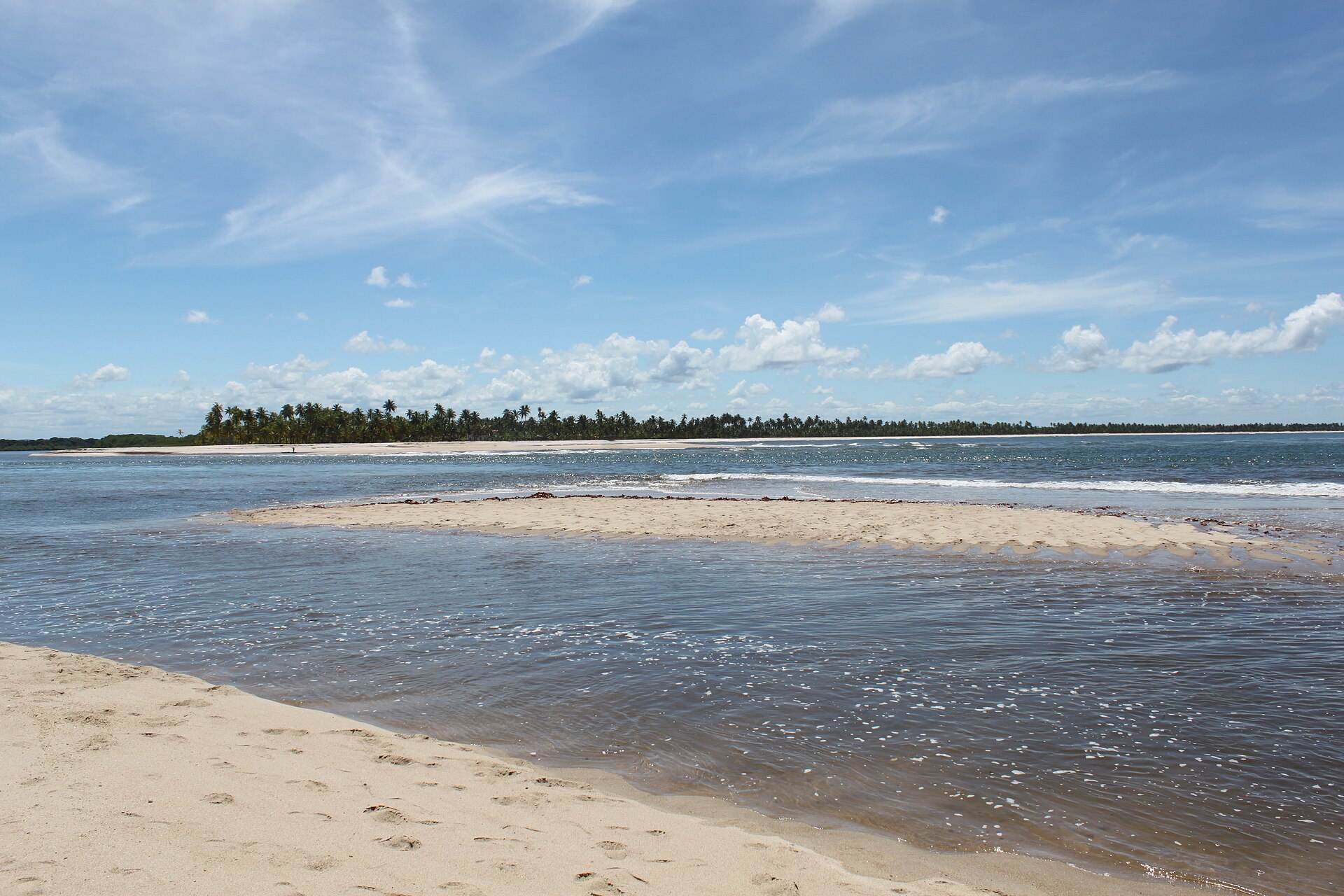
When someone says the natural pools of Boipeba, they almost always mean Moreré. The village sits six kilometres south of Velha Boipeba, and the reef line lies about a kilometre offshore, straight out in front of Praia de Moreré.
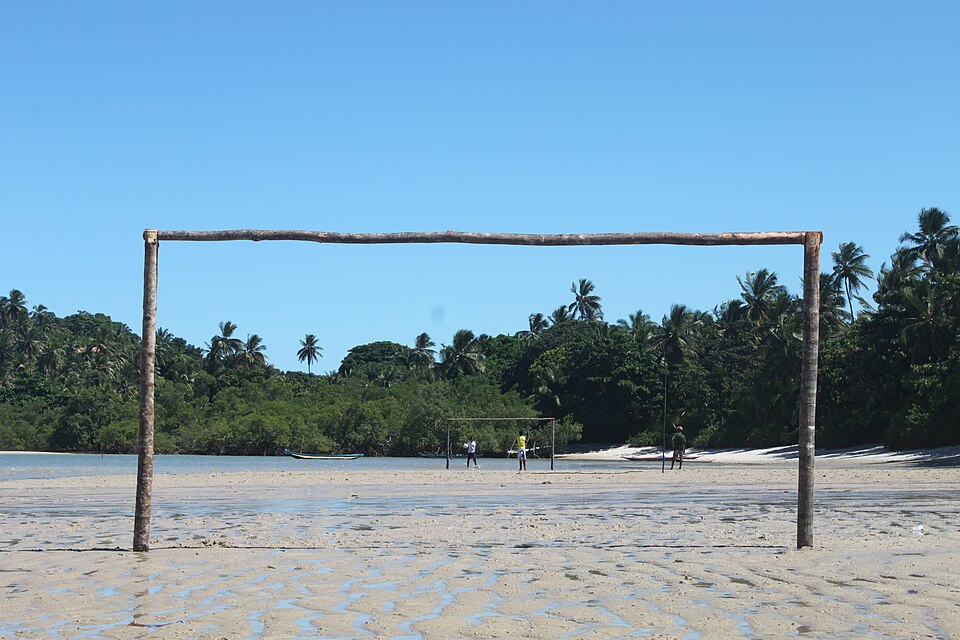
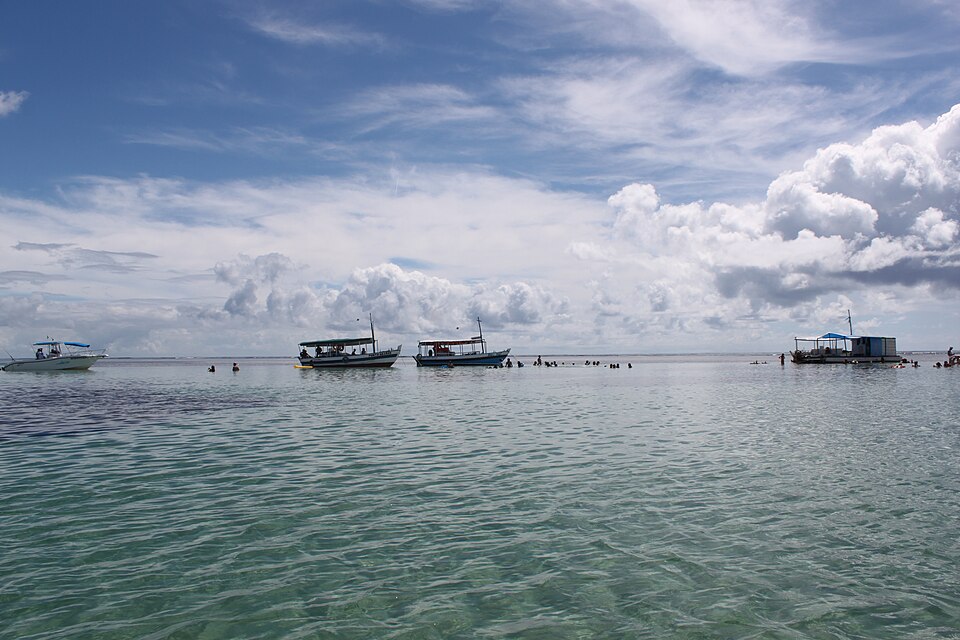
Local boatmen run you out from the beach for a small fee, negotiated on the sand, and on a very low spring tide people wade a good part of the way. In season a floating bar anchors on the bank and serves cold drinks and seafood snacks at tables standing in ankle-deep water, which is either the best or the strangest bar you will drink at this year.
You can reach Moreré by tractor, by quad-bike taxi, by boat or on foot along the sand at low tide. We cover all four in our guide to getting around the island.
Bainema: the ones the group tour skips
South of Moreré the beach opens into Bainema, and off the point known as Pontal de Bainema there is a second set of pools, roughly 680 m from the sand. They are much less visited for one boring commercial reason: the collective tours do not stop there. Reaching them means a private charter, which costs more and runs less often.
If quiet water matters more to you than saving money, ask us the week before you arrive and we will find out who is running private boats and what they are charging that month. Confirm it with us on WhatsApp rather than assuming.
Matching a boat tour to the tide
The classic Volta à Ilha costs about R$250 per person in 2026, takes around seven hours, and leaves from Boca da Barra between 9 and 10 in the morning specifically because the departure is set by the tide, not by the clock. It returns between 16:00 and 17:30. Stops are the Moreré pools, Ponta dos Castelhanos, lunch at the fishing village of Cova da Onça, and oysters at sunset on the way home. Boat and boatman are included; lunch, drinks and oysters are not.
If you only want the pools, there is a shorter Moreré trip at around R$120 per person. Either way the pilots adjust the route on the day to hit at least one set of pools at the lowest water.
The planning order matters. Look at the tide table first, choose the date, then book the boat. Doing it the other way round is how people end up paying full price for a scenic cruise. Prices and times were checked for 2025 and 2026 and they move, so confirm the current figure with us on WhatsApp before you commit. There is more detail in our boat tours and prices guide.
Currents, and the part we are serious about
Two metres of water has to go somewhere twice a day, and here it goes through river mouths and through the narrow channels between reef heads. Those channels can run faster than you can swim, and they look calm from above.
- Never swim alone on the banks, and never at a river mouth.
- Keep an eye on the boat. It is your water-level gauge, and when it starts sitting higher, the walk back has already got longer.
- Wear reef shoes. Sea urchins live in the crevices and dead coral cuts like broken tile.
- Sun bouncing off ten centimetres of water burns twice as fast. A long-sleeved lycra shirt beats reapplying sunscreen every hour, and it keeps chemicals out of the water.
- Tell someone at the flats where you are going if you walk out on your own.
Snorkelling here
A mask and a snorkel are enough. Leave the fins on the boat when the water is shallow, because fins in half a metre of water end with someone's heel in a coral head.
What you see, on a good low tide with the sun high: sergeant majors in clouds, parrotfish working the rock, the occasional small ray crossing the sand, an octopus if you are patient and looking into crevices rather than out at the blue. Light matters as much as depth, so between 10:00 and 14:00 the colours are simply better. Bring your own mask if you are particular about fit; rental gear exists on the beach but the sizes are a lottery.
What you never do to the coral
The reef is alive and slow. A colony that takes decades to grow can be killed by one person steadying themselves on it for three seconds.
- Never stand, sit, kneel or lean on coral. If you need to rest, find sand.
- Never break off a piece, and never take one home from the beach either.
- Never feed the fish, including bread from the boat.
- Never wear ordinary sunscreen in the pools. Oxybenzone and octinoxate are the two ingredients to check for on the label.
- Never leave anything behind, including cigarette ends and fruit peel.
None of this is decoration. Boipeba sits inside a state protected area, the APA das Ilhas de Tinharé e Boipeba, created in 1992 and covering 43,300 hectares in the municipality of Cairu, and five reefs in this region have been classified as high priority for conservation.
If your week has bad tides
Here is the honest part. If the only low waters during your stay fall at six in the morning or six in the evening, the pools will not look like the photographs, and we would rather tell you that before you book than after you arrive.
It is not a wasted trip. A dawn low tide is genuinely beautiful and completely empty, if you can get up. Boca da Barra is two minutes from our door, the walk to Cueira takes about 45 minutes on firm sand, and the boat ride around the island is worth doing for the island itself. Send us your dates and we will read the table with you before you pay for anything. The flats page shows what each one includes, and how to get here covers the boats from Salvador and Valença, because the last one leaves at four.
Frequently asked questions
What tide height do the Boipeba natural pools need? A low water under 0.5 m is the practical threshold, and under 0.3 m is the postcard. The usable window is about two hours either side of the lowest point.
Which tide table should I use for Boipeba? There is no station on the island, so use Morro de São Paulo, about 26 km away. The official predictions come from the Brazilian Navy's Centro de Hidrografia da Marinha at marinha.mil.br/chm; apps repeat them.
Can I walk to the Moreré natural pools instead of taking a boat? On a very low spring tide people wade a good part of the kilometre, but the safe and normal way is a local boat from the beach for a small fee. Never walk out alone on a rising tide.
How far ahead should I book the boat tour? Choose the date from the tide table first, then book, usually a day or two ahead in low season and several days ahead between late December and Carnival. Ask us and we will look at the table with you.
Send us the dates you are considering and we will tell you which afternoon the reef opens: see the flats and read how to get here before you book the boats.